All Posts By

christy.kessler

Funeral Basics Glossary: D

By Glossary

As with any profession, the funeral profession has its jargon, a specialized vocabulary unique to the business. Only those intimately familiar with the profession know what everything actually means. At times, this can be a problem because people need to be able to understand in order to make good decisions. Therefore, the need for a glossary! Hopefully, it will help you better understand any future conversations you may have with funeral professionals.

Death Benefits

When a person dies, surviving family members may be eligible for benefits through the Social Security office or the Department of Veterans Affairs.

Death Certificate

A death certificate is a document issued by a medical practitioner that certifies the deceased state of a person and declares the date, location, and cause of the person’s death. The death certificate must be filed with the state’s Office of Vital Statistics.

Death Notice

A death notice announces the death of a person. Most often, newspapers and legal registries list them. A death notice differs from an obituary in that it does not include biographical facts or a chronological description of milestones in a person’s life. It is simply a formal announcement of the death of a person and shares funeral service information.

Deceased

A person who has died.

Digital Assets

Digital assets may include personal email and texts; creative assets such as logos, illustrations, animations, websites, and audio/visual media; digital files such as presentations, spreadsheets, photos, and documents; and online accounts such as online businesses, blogs, subscription services, social media accounts, and networking profiles. This list is not comprehensive but is intended to give you an idea of the array of things that fall under digital assets. Digital Estate is another term for this.

Digital Estate

See Digital Assets.

Digital Executor

A digital executor is a person or online service chosen to act on your behalf in relation to your digital assets after your death. They will distribute or delete your digital assets according to your final wishes as stated in your will. A digital executor should be able to understand and manage the technical aspects associated with digital assets. Ask a capable, trusted friend or loved one to accept this responsibility.

Digital Legacy

A digital legacy is created to preserve your digital assets online after your death for future generations.

Direct Burial

A direct burial occurs shortly after death with no formal funeral or committal service. No embalming is necessary since there is no viewing or visitation.

Direct Cremation

A direct cremation occurs shortly after death with no formal funeral or committal service. A funeral service provider oversees the cremation process and later returns the remains to the family.

Disinter

The act of removing a body from a grave or tomb.

Disposition

The final process of legally disposing of a deceased body. The most common forms of final disposition are burial and cremation. Other less common forms are burial at sea, alkaline hydrolysis, and anatomical donation.

Display Room

A room in a funeral home specifically for displaying funeral or memorial merchandise. Items include caskets, urns, casket liners, cremation jewelry, and burial/urn vaults.

Do Not Resuscitate Order (DNR)

This is a legal document that prevents medical personnel from doing cardiopulmonary resuscitation (CPR) to prolong or save your life.

Double Crypt

See Crypt.

Dove Release

At some funeral or memorial services, families perform a dove release. The doves are used to signify “letting go” of grief and embracing love, peace, hope, the soul, and/or The Holy Spirit.

Dressing

The act of clothing the deceased for burial and/or visitation.

Durable Power of Attorney (DPOA)

A Durable Power of Attorney (DPOA) is a legal document that gives a person of your choice the power to act on your behalf in relation to your financial or legal matters if you ever become mentally incapacitated and unable to handle matters on your own. Ask a trusted friend or loved one to accept this responsibility.

Funeral Basics Glossary: E

By Glossary

As with any profession, the funeral profession has its jargon, a specialized vocabulary unique to the business. Only those intimately familiar with the profession know what everything actually means. At times, this can be a problem because people need to be able to understand in order to make good decisions. Therefore, the need for a glossary! Hopefully, it will help you better understand any future conversations you may have with funeral professionals.

Embalming

Temporarily preserving the deceased by disinfecting the body and injecting embalming chemicals into the veins and arteries. This is meant to preserve the body until all funeral functions are complete.

Entombment

Placing the body into a burial chamber, often above the ground and in a mausoleum, crypt, or family tomb.

Epitaph

An inscription on a tomb/grave in remembrance of the deceased.

Eulogy

Usually given during a funeral or memorial service, a eulogy honors the life of a deceased loved one.

Executor

An executor is the personal representative appointed to carry out final instructions and wishes after death has occurred, as documented in a deceased person’s will. This includes participation in the probate process and distribution of assets. Ask a trusted friend or loved one to accept this responsibility.

Exhume

The removal of the body from the burial site; a synonym of disinter.

Funeral Basics Glossary: F

By Glossary

As with any profession, the funeral profession has its jargon, a specialized vocabulary unique to the business. Only those intimately familiar with the profession know what everything actually means. At times, this can be a problem because people need to be able to understand in order to make good decisions. Therefore, the need for a glossary! Hopefully, it will help you better understand any future conversations you may have with funeral professionals.

Family Car

The vehicle that transports the family of the deceased during the funeral procession. Oftentimes, it is a limousine.

Family Room

A room provided to the family for privacy. The family has access to the room during the funeral service.

Flower Car

The vehicle specifically used for the transportation of flower arrangements from the funeral service location to the cemetery or final disposition location.

Final Disposition

See Disposition.

First Call

When the funeral director first visits the place of death to remove the body and to obtain essential information, such as vital statistics.

Fiduciary or Fiduciary Power of Attorney (FPOA)

A Fiduciary or Fiduciary Power of Attorney (FPOA) gives legal power to the person you appoint to act on your behalf regarding financial matters if you become unable to do so yourself. You may appoint the same person to serve as your Medical Power of Attorney. Ask a trusted friend or loved one to accept this responsibility.

FTC Funeral Rule

The Funeral Rule, enforced by the Federal Trade Commission (FTC), requires that all funeral homes maintain a General Price List (GPL). This list is available to any consumer who wishes to see it. The consumer can choose only the goods and services they want or need.

Full Couch Casket

A casket with a lid that opens completely.

Full-Service Funeral

A funeral that typically includes a viewing and visitation, formal ceremony, a committal service, and a burial or entombment.

Funeral

A ceremony/service that honors, celebrates, and commemorates the life of a person who has died.

Funeral Carriage

Transportation of the body by horse-drawn carriage.

Funeral Chapel

A dedicated room or facility similar to a religious chapel where mourners can gather for a visitation, funeral ceremony, or memorial service.

Funeral Coach

See Hearse or Funeral Carriage.

Funeral Director

A funeral director arranges for the care, transportation, preparation and burial or cremation of a deceased person. Additional responsibilities include filing the death certificate or other forms; transferring the body; arranging the funeral, wake or viewing; coordinating with cemetery or crematory representatives; and moving the body to the cemetery or crematory. A funeral director may also provide support services to a deceased loved one’s family.

Funeral Escort

The term used for law enforcement or other individuals who accompany a funeral procession to the cemetery.

Funeral Home

A business that provides assorted services for funeral arrangements. It is also the building where the arrangements are made for any funeral/memorial services, where visitations and services are often held, and where the deceased are prepared for burial/cremation.

Funeral Insurance

Insurance that establishes a written, pre-funded document or policy that helps to finance the costs of funeral/memorial and cremation/burial expenses.

Funeral Mass

A funeral service observed by the Catholic denomination that takes place the day after the wake/vigil.

Funeral Plan

A funeral plan is a written record of your final wishes for your end-of-life events and services. It may include your funeral service preferences as well as your choices for flowers, music, readings, speakers or attendees. A copy of the funeral plan is typically stored at a funeral home, in a safe deposit box or in a home safe. A funeral plan may or may not be paid for in advance. It should state the location of important documents such as your will, life insurance policies, birth certificates, marriage license, military records and credit obligations.

Funeral Service

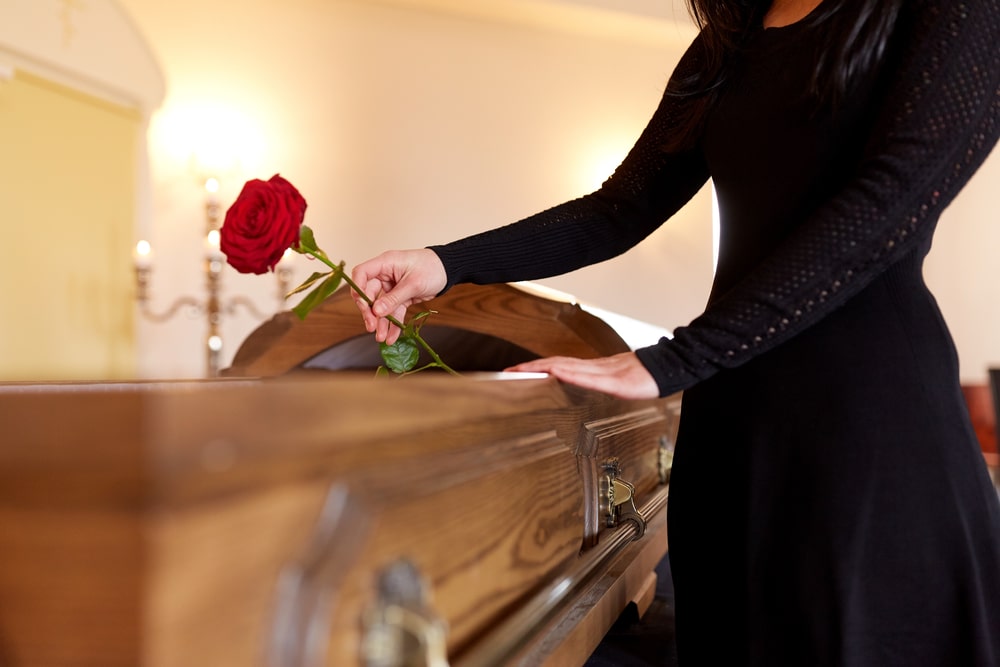
A funeral service is an important end-of-life event that commemorates a deceased loved one. A funeral provides a time and place for loved ones to grieve and allows friends and family to show their support. A traditional funeral service is typically held within a few days of the death, often with the deceased love one present in a casket. The funeral service is often held in a funeral home, religious place of worship, or a chapel at the cemetery (though other locations are also possible) before cremation or burial. A funeral service may incorporate an open-casket visitation of the loved one’s remains prior to the funeral service and/or a procession to the burial site immediately following.

Funeral Service Provider

See Funeral Director.

Funeral Spray

The name given to the floral arrangements sent to the loved ones of the deceased to represent condolences and honor.

Funeral Trust

A funeral trust or burial trust is a funding option for a prepaid funeral and/or burial plan. The trust is often set up through a funeral home, who may agree to lock in costs for future funeral or burial services at an agreed-upon price. The funeral home sometimes serves as trustee or manager of trust assets, with the trust owner typically funding the trust with cash, bonds, or a specialized life insurance policy. A funeral trust can be revocable or irrevocable. An irrevocable trust would be beneficial for individuals who need to spend down assets in order to qualify for Medicaid assistance for long-term care.

Funeral Basics Glossary: G, H, I

By Glossary

As with any profession, the funeral profession has its jargon, a specialized vocabulary unique to the business. Only those intimately familiar with the profession know what everything actually means. At times, this can be a problem because people need to be able to understand in order to make good decisions. Therefore, the need for a glossary! Hopefully, it will help you better understand any future conversations you may have with funeral professionals.

G

Gathering

A gathering occurs after the graveside or committal service. It is an opportunity for friends and family to come together and continue to share memories, express condolences, and comfort and support each other. A gathering may be either public and open to anyone or private with only select family or friends in attendance.

General Price List (GPL)

The GPL is a list of all the products and services that a funeral home offers for sale. All funeral homes are required by the Federal Trade Commission’s Funeral Rule to provide a General Price List to any consumer upon request.

Grave

A grave is an excavated portion of ground where a deceased loved one is placed or “interred,” which is later covered with dirt, clay or cement.

Grave Liner

Typically made of concrete, a grave liner is the container that covers the casket in the ground after burial. It keeps the grave from caving or sinking in. Most cemeteries require a grave liner; however, they are not required by the state.

Graveside Service

A graveside service, sometimes called a “committal service,” is a funeral service that is held at the gravesite in a cemetery. The graveside service may take place at a burial plot, mausoleum, columbarium, or other final disposition site chosen. Like a traditional service, it provides a final opportunity for mourners to honor and say goodbye to their deceased loved one. A speaker often leads and concludes the service.

Gravestone

See Headstone.

Green Burial

A burial with minimal environmental impact. Green burials do not typically include embalming but can include natural burial and nontoxic biodegradable casket/urns.

Green Funeral

See Green Burial.

H

Half Couch Casket

A casket that covers the body of the deceased from the waist up.

Headstone

A headstone is a stone tablet set at the head of a grave that is typically inscribed with the name, birth and death date of the deceased loved one. A headstone is also called a gravestone, marker, physical memorial, or tombstone.

Hearse

A vehicle designed to carry the deceased’s body in a casket or coffin from the place of the funeral service to the cemetery.

Honorarium

The minister’s, celebrant’s, and/or musician’s payment for their service at the funeral/memorial ceremony.

Honorary Pallbearers

Family, friends, or members of a religious group specifically asked by the deceased’s loved ones to escort or honor guard the casket. Unlike active pallbearers, honorary pallbearers do not actually carry the casket.

I

Inquest

The legal inquiry into a cause of death, especially if it is a violent or unexpected passing.

Inscription

Engraved words/markings on a tombstone or memorial (closely related to an epitaph).

Interment

Interment is the burial of a deceased loved one’s remains (cremated or otherwise) into a grave or tomb, typically in conjunction with funeral services.

Inurnment

The placement of an urn in a resting place, such as a niche or columbarium.

In Lieu of Flowers

A request made by the deceased’s loved ones that mourners show their condolences by contributing to a specific charity or organization instead of sending flowers.

In State

Sometimes, when a public figure dies, their body is laid in a public place to allow mourners to pay their respects before the burial. A longer version of this concept is to Lie in State.

Insurance Assignment

Insurance assignment allows a person to transfer the ownership rights of a policy to a third party, such as a funeral home or an insurance assignment company. The funeral home may accept a life insurance policy in lieu of payment. An insurance assignment company verifies the validity of the policy, advances the family funds within 48 hours, and then works with the insurance company to receive reimbursement.

Irrevocable Contract

A contract that cannot be revoked or cancelled, most often set up as a Medicaid-exempt asset in the case of a prepaid funeral policy or trust. This allows the asset to be excluded from consideration for an individual who is attempting to qualify for assistance from Medicaid to cover nursing home expenses.

Funeral Basics Glossary: J, K, L

By Glossary

As with any profession, the funeral profession has its jargon, a specialized vocabulary unique to the business. Only those intimately familiar with the profession know what everything actually means. At times, this can be a problem because people need to be able to understand in order to make good decisions. Therefore, the need for a glossary! Hopefully, it will help you better understand any future conversations you may have with funeral professionals.

J

K

Keepsake Jewelry

See Cremation Jewelry.

L

Lapsed Policy

A lapse occurs when someone does not pay the required number of payments on an insurance policy. If a lapse occurs, the beneficiaries may receive nothing. Legally, the insurance company does not have to pay out on a lapsed policy. Typically, this only happens when a life insurance company does not receive premiums due after the grace period has passed.

Last Rites

The last prayers prayed over a person before death occurs. They are often associated with the Catholic faith but are also a part of other religions.

Lead Car

The vehicle that leads the funeral procession to the church and cemetery. The funeral director and minister/celebrant typically ride in the lead car.

Lie in State

When the body of a widely known, honorable individual is laid in a public place for mourners to pay their respects before the burial. This is sometimes shortened to In State.

Limousine

A stretch vehicle with seats for many individuals behind the driver’s seat. Typically, a limousine carries the deceased’s close relatives in the funeral procession.

Lump-Sum Death Benefit

A one-time payment from a life insurance policy and/or the Social Security Administration, for example, to be paid on the death of an individual. The lump sum is paid to the policy beneficiary or the surviving spouse or child, in the case of the Social Security benefit.

Funeral Basics Glossary: M, N, O

By Glossary

As with any profession, the funeral profession has its jargon, a specialized vocabulary unique to the business. Only those intimately familiar with the profession know what everything actually means. At times, this can be a problem because people need to be able to understand in order to make good decisions. Therefore, the need for a glossary! Hopefully, it will help you better understand any future conversations you may have with funeral professionals.

M

Marker

A marker is a stone tablet set at the head of a grave, typically inscribed with the name, birth and death date of the deceased loved one. A marker is sometimes called a gravestone, headstone, physical memorial, or tombstone.

Mausoleum

A large building that serves as a tomb for either one or multiple deceased bodies.

Medical Power of Attorney (MPOA)

A MPOA is a legal document that allows you to legally appoint someone to make medical decisions for you if you become unable to make your own medical decisions. This document, also called an Advance Healthcare Directive, Healthcare Proxy or Treatment Directive, states your choices for medical treatment. You may appoint the same person to serve as your Fiduciary Power of Attorney. Ask a trusted friend or loved one to accept this responsibility.

Memorial Service

A memorial service is an event held to remember a deceased loved one and is most commonly held several days and sometimes up to a year after burial or cremation. The deceased loved one’s remains are not present. A memorial service is often held when direct burial or direct cremation is selected in place of a funeral.

Memorial Donation

See In Lieu of Flowers.

Memorial Video

A video composed of pictures and/or videos of the deceased, often played at the memorial, visitation, and/or funeral. Typically, the funeral home creates the memorial video with content given to them by the family; however, the family can make their own video if they want. Also referred to as a tribute video.

Memorial Folders

A memorial folder is another name for the funeral program. Typically, the memorial folder contains the order of service for the funeral, along with the obituary, poems or readings, and a photo of the deceased.

Memorial Jewelry

See Cremation Jewelry.

Memorial Tribute

A memorial tribute is anything someone does or says in honor of someone who has died. Memorial tributes can include a speech given at a funeral or memorial service, letters, notes, poems, songs, paintings, videos, or even charitable donations given in memory of a loved one’s life.

Memorial Website

An internet site where users can create virtual memorials for deceased loved ones. Depending on the features of the website, tributes can be made through text, pictures, videos, etc. Some memorial websites may require users to pay a fee to add their tribute.

Monument

A memorial structure to commemorate a person. It may be a headstone, marker, or physical memorial that is placed at the head of a grave, or it may be a stand-alone structure dedicated to the memory of the deceased.

Morgue

A facility, typically in a hospital or city or county medical examiner’s office, where deceased persons are taken to await identification, an autopsy, or transfer to a funeral home for preparation for final disposition.

Mortician

See Funeral Director.

Mortuary

See Funeral Home.

Motorcycle Hearse

A type of hearse used to carry a deceased body. There are two main types of motorcycle hearses. A normal motorcycle connects to a special sidecar, designed to carry the casket or urn. The other type of motorcycle resembles a trike and carries the casket/urn behind the motorcyclist.

Mourner

An individual who attends the funeral to grieve and to convey respect and honor to the deceased and their family/friends.

N

Next of Kin

An individual’s closest living relative, usually the spouse, child, parent, or sibling of the deceased. Oftentimes, this person inherits the deceased’s private property.

Niche

A small space located in a mausoleum or columbarium wall to hold an urn.

Niche Garden

A garden that contains columbarium, mausoleums, and/or niche walls to hold urns.

O

Obituary

An obituary is a written notice to commemorate a deceased loved one that typically includes a biography of facts and milestone events that memorialize a person’s life. Many times, it includes information about upcoming funeral or memorial services, and either the funeral home or a newspaper publishes it online or in a newspaper.

Officiant

A person who leads or officiates at a funeral or memorial service, often clergy.

Online Memorial

An online memorial is a digital space created to commemorate a deceased loved one. Memorials can be a single HTML webpage with the deceased’s name and a few words of tribute, or may be much more extensive. Multimedia content is common, including music, videos and stories and photos provided by friends and family. Create a timeline of the deceased loved one’s life, a family tree, a blog or journal. Also see Virtual Memorial.

Opening & Closing Fees

The cost associated with digging and filling the grave for burial. The cemetery determines the actual cost.

Organ Donation Form

If you choose to be an organ donor, this legal form provides proof that you want to donate organs or tissues after your death.

Ossuary

An option for a final resting place. Historically, an ossuary contained the bones of deceased persons, but in modern day, an ossuary is usually a place where cremated remains can be scattered legally.

Funeral Basics Glossary: P, Q, R

By Glossary

As with any profession, the funeral profession has its jargon, a specialized vocabulary unique to the business. Only those intimately familiar with the profession know what everything actually means. At times, this can be a problem because people need to be able to understand in order to make good decisions. Therefore, the need for a glossary! Hopefully, it will help you better understand any future conversations you may have with funeral professionals.

P

Pallbearers

The individuals who are responsible for carrying the casket of the deceased. Typically, there are four to eight pallbearers, and they can be whomever you want. Most often, they are friends and family members. The funeral home can help arrange for pallbearers if needed.

Perpetual Care Trust Funds

A portion of the burial plot cost set aside in a trust fund for the ongoing care of the burial plot.

Personalization

A growing trend in funeral planning. The main idea is to make each funeral personalized and unique to the person who has died, rather than have cookie-cutter type funerals.

Physical Memorial

See Headstone.

Plot

An area of ground in a cemetery used for the interment of human remains. See also Burial Plot and Cemetery Plot.

Power of Attorney (POA)

A Power of Attorney is a legal document that gives someone you choose the power to act on your behalf if you ever become mentally incapacitated. A Power of Attorney document is sometimes called a “Durable” Power of Attorney for medical care and finances. A Durable Power of Attorney simply means that the document stays in effect if you become incapacitated and are unable to handle matters on your own. Ask a trusted friend or loved one to accept this responsibility.

Prayer Card

A card with a prayer or poem on it, handed out to guests at a funeral. Normally, the card has a picture of the deceased and their birth and death date.

Prearrangements

Advance funeral plans are sometimes referred to as prearrangements. Prearrangement offers a detailed record of a person’s funeral wishes, including service types, merchandise selections, and cash advance items (third-party charges such as flowers, cemetery property, police escort, etc.)

Prefunded Funeral Plan

A prepaid or prefunded funeral plan establishes a written and funded document or policy that covers the costs of funeral, cremation or burial expenses.

Preneed Plan

Refers to the written funeral wishes of an individual. Though not required, it can be a prepaid or prefunded insurance plan that establishes a written and funded document or policy that covers the costs of funeral, cremation or burial expenses.

Prepaid Funeral Insurance Plan

A prepaid or prefunded insurance plan establishes a written and funded document or policy that covers the costs of funeral, cremation or burial expenses.

Preparation Room

When a loved one has died and is tranferred into the care of a funeral home, the body is taken to the preparation room for care and preparation, including embalming, dressing, cosmetics, and placement in a casket for burial.

Premium

A premium is the periodic payment required to keep an insurance policy in force.

Presidential Memorial Certificate

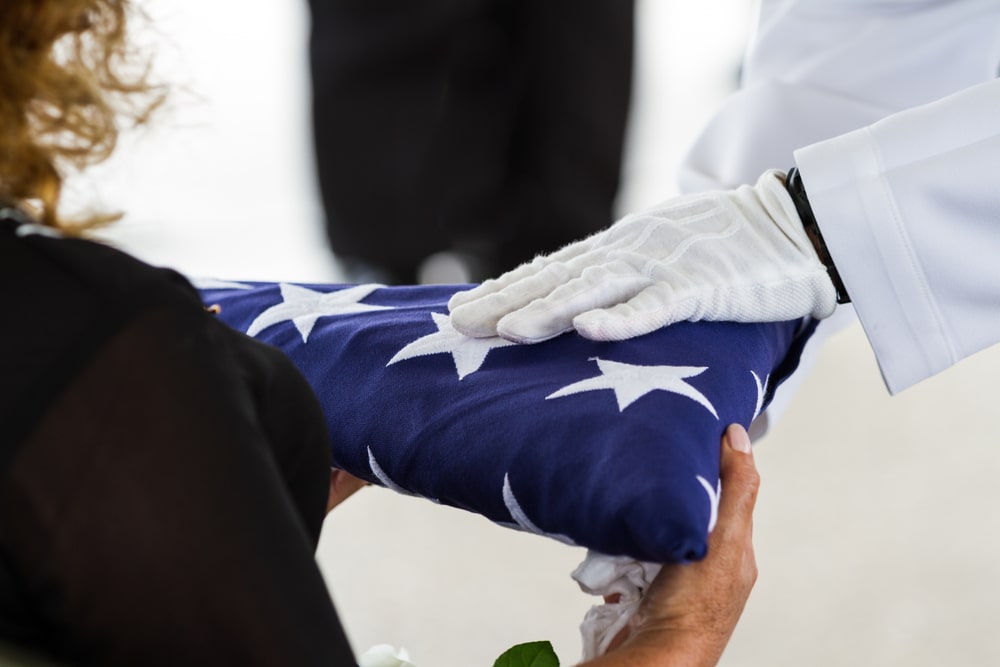
A certificate signed by the current President of the United States, given in memory of a deceased veteran’s service to the country.

Private Family Estate

This term refers to land that is privately owned by a family. Sometimes families have buried or cremated remains of deceased relatives on private family estates.

Private Family Mausoleum

A mausoleum built to hold multiple deceased individuals from the same family.

Private Service

A funeral service attended only by close family and friends that is not made open to the public.

Private Viewing

A viewing of the open casket, available only for close friends and immediate family.

Probate

A court-supervised process by which a person’s assets are transferred to beneficiaries. If no will is in place, probate court decides how to distribute or transfer assets when a deceased person has a measurable estate.

Procession

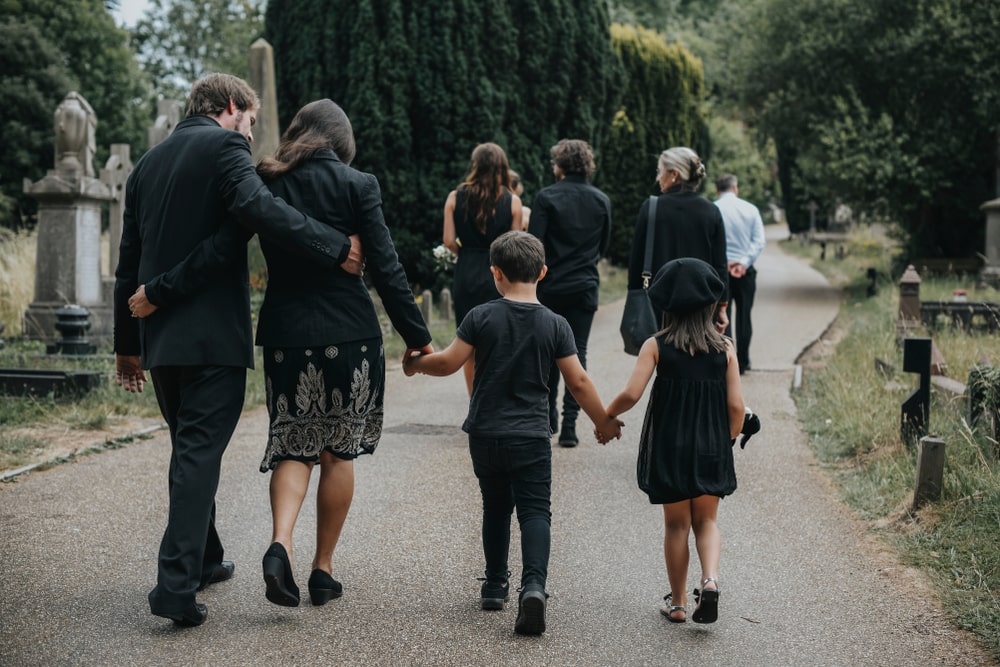
A procession to the graveside helps families transition from the funeral service to the committal service and provides a symbol of unity and support, as friends and family travel together to the graveside. Most community members also choose to stop and allow the procession to pass out respect for the grieving family.

Q

R

Register Book

A sign-in book for guests who attend the visitation, memorial, or funeral, which gives family members a record of everyone who attended the funeral events.

Remains

A term used to refer to a person’s body after death.

Removal

A term referring to the transfer of a deceased person’s body into the care of a funeral professional from the place of death.

Rental Casket

A ceremonial casket that is used only for public viewings or funeral services. The rental casket is able to hold a second cremation or alternative casket as an insert. Once the funeral ceremony is completed, the smaller, less ornate interior casket is removed and transferred to the cemetery or crematory for final disposition. A rental casket can offer a less expensive, more environmentally friendly option for families who desire a funeral ceremony prior to cremation or green burial.

Retort

The cremation chamber at a crematory used for final disposition.

Funeral Basics Glossary: S, T, U

By Glossary

As with any profession, the funeral profession has its jargon, a specialized vocabulary unique to the business. Only those intimately familiar with the profession know what everything actually means. At times, this can be a problem because people need to be able to understand in order to make good decisions. Therefore, the need for a glossary! Hopefully, it will help you better understand any future conversations you may have with funeral professionals.

S

Scattering Garden

A specific area designated for the scattering of ashes. Normally, a scattering garden is located at a cemetery.

Scattering Service

A ceremony honoring the deceased by the dispersion of their ashes.

Selection Room

See Display Room.

Service Car

A car used to carry any equipment and decorations necessary for a funeral or memorial service.

Show Room

See Display Room.

Survivors

A term most often given to any family members who remain living after someone has died.

Sympathy Card

A message sent to someone who has recently lost a loved one, expressing condolences.

T

Tent

See Canopy.

Term Life Insurance

Term Life Insurance offers insurance benefits coverage for a limited number of years. It expires without value if the insured lives for the duration of the defined period and is often a term of five to 20 years.

Tomb

A large vault or chamber used as a final resting place. It is normally an above-ground structure as opposed to a grave that is below the ground.

Tombstone

See Headstone.

Transit Permit

A legal document granting permission for the deceased to be taken to a cemetery. The local government issues these permits. Depending on the city’s specific rules, an additional permit may be required if the deceased is to be cremated.

Transportation of Deceased

See Hearse.

Trust

A trust establishes a set of written directions determined by its creator, called the “settlor.” A valid trust must include trust provisions, a trustee, a beneficiary, and assets transferred to the trust. A trust consists of specific directions written by its creator, instructing the trustee how to hold property or assets for a beneficiary.

Trustee

A trustee is the person who manages a trust. The primary trustee is the initial manager of the trust. A successor trustee takes over after the initial manager resigns or is incapacitated or deceased.

U

Undertaker

A person who “undertakes” the task of preparing a body for burial or cremation and makes arrangements for the funeral. Also called a mortician or funeral director.

Urn

A decorative or functional container used for storing the remains of a cremated body. Urns can be made from almost any material, including glass, wood, ceramic, or metal. Urns may also be biodegradable if they are to be buried in the earth or at sea.

Urn Ark

A large, decorative box made of wood with glass panels that is used to hold and carry an urn throughout a funeral and committal ceremony.

Urn Garden

An area dedicated to the burial of urns. Plots are generally much smaller than full-sized burial plots.

Urn Placement

The committal of an urn to its final place of rest, such as in a columbarium, niche, urn garden, or private family estate.

Funeral Basics Glossary: V, W, X, Y, Z

By Glossary

As with any profession, the funeral profession has its jargon, a specialized vocabulary unique to the business. Only those intimately familiar with the profession know what everything actually means. At times, this can be a problem because people need to be able to understand in order to make good decisions. Therefore, the need for a glossary! Hopefully, it will help you better understand any future conversations you may have with funeral professionals.

V

Vault

Another type of grave liner, a burial vault is often required by cemeteries to encase a casket in order to prevent graves from sinking or caving in and to preserve the aesthetic beauty of the cemetery grounds. Vaults are usually made of concrete and offer more protection from the elements than grave liners.

Veterans Cemetery

A national or state cemetery run by the Department of Veterans Affairs specifically for the burial of eligible veterans and their dependents.

Viewing

A scheduled time for guests to see the deceased body after it has been properly prepared for burial or cremation. Oftentimes, a viewing occurs just before the funeral service begins. One key difference between a viewing and a visitation is that the family of the deceased are not necessarily available to receive condolences at a viewing.

Vigil

A Catholic religious service held the evening before the funeral.

Virtual Memorial

A virtual memorial is a digital space created to commemorate a deceased loved one. Memorials can be a single HTML webpage with the deceased’s name and a few words of tribute, or may be much more extensive. Multimedia content is common, including music, videos and stories and photos provided by friends and family. A timeline of the deceased loved one’s life, a family tree, a blog or journal may be created. Also see Online Memorial.

Visitation

This is a time when the family is available to friends and other family members who wish to express their sympathies directly. In some cases, the body of the deceased is also present so mourners may pay their respects to the deceased as well.

Visitation Room

The room where the deceased body lies for guests to view before a funeral service.

Vital Statistics

This term refers to information regarding births, deaths, marriages, divorces, veteran status, and social security number.

W

Wake

The gathering of family and friends before a funeral to mourn and honor the dead. Traditional wakes are held in the home, with the body present, and a meal is usually served. Sometimes, a person, or persons, are designated to sit up with and guard the deceased body through the night. The wake can last the entire night preceding the funeral.

Web Streaming

A technological advance that allows the funeral or memorial service to be streamed over the internet in real time for guests who are unable to attend. They can watch the event on their computer or electronic device.

Will

A will, also called a “Last Will and Testament,” is a legal document in which a person states their final wishes for the transfer of their assets after death.

Whole Life Insurance

Whole Life Insurance is also known as Ordinary, Standard or Permanent life insurance. Unlike term insurance, whole life insurance provides insurance coverage for the lifetime of the insured. Whole life insurance policies also provide tax-deferred buildup of cash value, payable upon surrender or payment default. Generally, permanent insurance has fixed premiums and death benefits. Other types of permanent coverage, such as Graded Premium Life, Universal Life, and Variable Life, offer variable premiums and death benefits.

X

Y

Z

Understanding the Opioid Crisis and What You Can Do to Help

By Current Events, Grief/Loss

So many families across the United States are affected by the grief, anger, and confusion over the death of a loved one by overdose. Every day, more than 130 people in the United States die from opioid overdose. According to the National Safety Council, Americans are now more likely to die of drug overdose than to die in a car crash.  That’s more than 47,000 people in one year. Additionally, the number of overdoses among women (ages 30-64) has increased by 260 percent in 20 years.  Because of these alarming trends, the life expectancy in America has steadily decreased in recent years. All of these statistics make it clear just how vast the need is to help those who are struggling with addiction to opioids and other drugs.

With such a crisis growing in our nation, what can we do? How do we help the people we love? How do we work to prevent future deaths? Let’s review a few simple tips that will help you understand what opioids are, recognize an addict, and discover how you can make a difference.

Understand what opioids are

Let’s take a moment to understand what qualifies as an opioid. An opioid is a class of drugs that include illegal heroin, synthetic opioids (fentanyl) and prescription pain relievers (OxyContin, Vicodin, codeine, and morphine, to name a few). Fentanyl is 50 to 100 times more potent than morphine, and its use is on the rise. Opioids depress the body’s central nervous system, slowing down a person’s breathing. If you would like to learn what happens to the body during an overdose, click here. Warning: it may be too difficult for some to read the website’s content, especially those who have lost a loved one to opioid addiction.

Recognize the signs of an addict

As with any illness, there are specific signs and symptoms. The more familiar you are with what to look for, the more likely you are to recognize an addiction before it’s too late.

Common Symptoms:

  1. Neglected responsibilities – a person will stop caring about what used to be important. They will miss events, assignments, work, and will neglect aspects of life.
  2. Associating with unhealthy people – they will begin to spend time with people who are a negative influence and may take drugs themselves.
  3. Isolation – they will hide from the people who love them, often ashamed of their problem. They become depressed, anxious, and paranoid.
  4. Behavioral changes – the person begins to do things that are out of character. They may begin to steal, go to see doctors in hopes of getting a prescription, or have unexplained absences. Also, they may begin to ask for money frequently and be more concerned about getting it.
  5. Poor judgment – the person may have difficulty concentrating and their problem-solving skills may be affected. Additionally, they may seem detached from their surroundings.
  6. Physical symptoms – the person will show changes in appearance (weight loss or changes in hygiene), scabs or puncture marks, poor coordination, nausea, and digestive issues, like vomiting.
  7. Mood changes – the person may exhibit mood swings, depression, paranoia, or have sudden, unprovoked outbursts.

Learn how to help an addict

When considering how to help an addict, it’s first important to realize that you can help, but you cannot fight someone else’s battle. Addiction is a disease of the brain, something that is difficult to overcome but absolutely possible. However, the person struggling with an opioid addiction must want to change and must do the work of transformation themselves.

With that in mind, here are a few tips for helping an addict:

  1. Set boundaries and stand by them.
  2. Encourage the person to seek out help. They may not be able to search for treatment options on their own, so be ready to help. Also, if the process has caused you stress and pain, consider talking to a therapist yourself. You need support through this time, too.
  3. Set a healthy example. This may mean giving up some of your own habits.
  4. Be supportive, but don’t make excuses for them. The addict needs to deal with the consequences of their addiction. Again, this is not a battle you can fight on their behalf.

Practice compassion with those who have lost a loved one to addiction

Any grief is hard. Grieving a person who lost their life to addiction is even more difficult. When we grieve, our emotions are all over the place: anger, anxiety, sadness. But with deaths related to addiction or suicide, there is an added stigma to an already heartbreaking loss.

When you interact with someone who has lost a loved one to overdose, remember that they are struggling with more than the usual grief. They may feel guilty about not doing more to help. They may have a lot of unanswered questions. On top of everything else, they must deal with societal stigma surrounding the death. People are often far too quick to judge and too slow to offer compassion and acceptance. Make sure you aren’t one of those people – offer kindness and compassion instead.

Tell others what you’ve learned

So far, opioid deaths continue to rise. We must do what we can to speak with people, young and old, about the dangers of opioids, in all their forms. Most especially, talk to your children about the dangers of opioid abuse so that they can avoid falling into the trap of addiction.

And if you have lost a loved one to overdose, don’t be afraid to talk about what you’ve experienced. Your story, your loved one’s struggle, can make a difference in the lives of others. We all need to understand the very real impact of opioid addiction and actively work together to find a solution.

Lastly, for everyone who is mourning the death of a loved one to overdose, know that you are not alone. We all mourn. We mourn because we love. Take the time you need to mourn and grieve for the special, unique person you have lost.

Skip to content