All Posts By

christy.kessler

7 Ways to Keep Your Loved One’s Memory Alive

By AfterCare, Grief/Loss

Grief is not…a “two steps forward, one step backward” kind of journey; it is often one step forward, two steps in a circle, one step backward. It takes time, patience, and, yes, lots of backward motion before forward motion occurs.  – Dr. Alan Wolfelt

Losing someone we love is one of the most heartbreaking and difficult events we will ever face in life. While death deprives us of a loved one’s physical presence, that doesn’t mean we’ve lost everything we love about the person. Our relationship becomes one based on memory rather than physical presence. As Dr. Wolfelt states above, the grief journey is a meandering way, filled with many steps. And part of the journey is traveling back into our memories in order to move forward toward reconciliation with our loss. That said, our loved one may be gone, but their memory need never die. Below are several ways you can remember and honor your loved one’s memory long after they have gone on.

1. Celebrate your loved one’s birthday

The first birthday after your loved one has passed can be a painful a milestone. But it can also be a special time set aside to honor the one you love. Every year, take a few moments to be thankful for the life they lived and the positive ways they impacted you. You can look back on the wisdom shared, the joyful moments, the love and support you received, and you can honor those memories by sharing that wisdom, love, and support with others.

2. Host a dinner in their honor

Choose a special day (birthday, anniversary, Mother’s Day, for example) to honor your loved one’s memory by inviting a group of friends to dinner. You could hold it at the person’s favorite restaurant or craft a menu of dishes that your loved one particularly enjoyed, then share memories and receive support from friendships in your life.

3. Get involved

If your loved one favored a particular organization or charity, you can get involved with that group as a way of continuing your loved one’s legacy. Or, if they weren’t involved with a particular group, think about what they loved. Were they a teacher? Provide backpacks full of school supplies to kids in need. Did they enjoy walking at a particular park? Volunteer your time to maintain the park by picking up litter or ask about upkeep and/or gardening. Did they volunteer at the local soup kitchen? Consider volunteering and invite a few friends to join you.

4. Set up a permanent memorial and visit regularly

For those who are grieving, it’s often helpful to have a place to go where you feel close to the one you’ve lost. For many people, a memorial or gravesite becomes that special place. If there is not a gravesite, installing a memorial bench at a significant place or planting a memorial tree may be an alternative. You could even include a memorial plaque so that anyone who passes by will be touched by your loved one’s life.

5. Create a memorial video/memory box

This activity may be especially helpful for those with young children. Children’s memories fade over time, so a memorial video or memory box can help a child hold onto memories and form a connection with the person they love and miss. The child can see his or her loved one regularly and watch the video as much as needed. With a memory box, they can touch and hold items that once belonged to the person who died and create a connection in that way.

6. Create your own tradition

If your loved one enjoyed dominoes, play dominoes on their birthday. If your loved one enjoyed action movies, set up a monthly night to watch the newest one. Let’s say your loved one enjoyed reading westerns – commit to reading one a year in their memory. Did your loved one just adore bananas? Set up an evening of banana-flavored foods with friends. Banana bread. Strawberry-banana smoothies. Banana pudding or pancakes. Your grandmother’s banana punch. The possibilities are as unique are your loved one.

7. Visit special places

If you and your loved one had places you always enjoyed going together, continue to visit those places. Did you have a favorite coffee shop or bookstore? Perhaps a favorite vacation destination or state park? Go to those places and enjoy yourself while also setting aside time to remember your loved one. You might even consider writing them a letter each time you visit, telling them about a specific time you visited together or sharing how much you miss them.

Death does not stop us from loving those we’ve lost. The love stays with us. The relationship you shared is important and worth remembering and sharing with others. We all need an outlet to express what we are feeling on the inside, and these activities will help you do that. By taking part in any or all of these activities, you will feel closer to your lost loved one and create forward motion in your grief journey.

Guilt, Anger, and Other Normal Reactions to Loss

By AfterCare, Grief/Loss

We experience a wide range of emotions when faced with the death of a loved one. And those emotions aren’t the same for everyone. Perhaps, if everyone grieved in the same way, we could craft a formula for grief – something that worked every time. But that’s not how it works. There’s no “correct” response to death. Every grief journey is different, as are the emotions swirling around within us.

As you deal with emotional stress, it’s important to name your feelings and acknowledge them. Nationally renowned and respected grief expert Dr. Alan Wolfelt says, “I have worked with thousands of grieving people and they have taught me about many, many different thoughts and feelings after a death. Rest assured that whatever you are thinking and feeling, while in one sense your thoughts and feelings are completely unique to you, they are also usually a common human response to loss.” Whatever you’re feeling – whether it seems typical or unusual – is normal. There are, however, a few normal emotional reactions that are often viewed negatively – ones that we think we shouldn’t feel after a loss. Let’s take a few moments to discuss them.

Anger

If you are feeling angry, you are not alone. Your anger may stem from feeling helpless, powerless, or abandoned. It may also be directed at someone or something in particular, like the doctors, your loved one’s health choices, God, or even life in general.

It’s important to remember that being angry is a normal response. As long as you don’t hurt yourself or others, it’s good to find a way to vent your feelings. If you are able to articulate what you feel, then consider writing it down or talking with a safe person (either a counselor or a good friend). However, if your emotions are more explosive, you might try using a punching bag, running, or participating in some other physical activity to help you release your anger.

Also, pay close attention to your words and actions. You may be more irritable and easily triggered than normal, causing you to be short-tempered with those you love.

Anxiety, Fear

For some, death can stir up anxiety or fear. Questions may arise in your mind. Will I be okay? Does my life have any purpose after this? Will other people I love die soon, too? What if something happens to me?

Feelings of anxiety or fear are often triggered by feeling vulnerable or that your security is threatened. For example, a child who loses a parent may feel anxious or fearful about whether something will happen to their remaining parent as well. Other options are that fear and anxiety are learned responses (a previous experience has conditioned you to respond this way) or that you aren’t sure how you will be able to cope so your anxiety rises, or you are worried that other sad things might happen.

Guilt & Regret

Another common emotion after a loss is feeling guilty about what happened or what didn’t happen. However, in many cases, it is misplaced guilt, though that doesn’t make the feeling any less real. Someone might feel guilty for not being a donor match, for not calling or visiting more often, or for not doing more to prevent the death (such as in the cases of depression, suicide, or substance abuse).

If you are dealing with feelings of guilt, remember that, while it’s a normal reaction to feel this way, your feelings may not be accurate. Consider why you feel guilty and whether you might actually be feeling regretful. There is a difference. Guilt, by definition, means that you have intentionally done harm to the person who has died. However, regret means that you wish you had done something differently. The main difference between the two is intent.

If you determine that you are guilty of some wrongdoing, look for ways to make up for your mistake – write a letter to your lost loved one to apologize or ask forgiveness of other people affected by your actions. Also, try to forgive yourself. We all make mistakes. On the other hand, if you are feeling regret, work through your emotions. Determine what changes you can make to avoid regret in the future.

Relief

Relief may be one of the most common yet misunderstood emotions a person may experience after a death. We feel so strongly that we shouldn’t be relieved that we sometimes hide the fact that we are. But relief is to be expected, especially after a period of intense or prolonged suffering (as is the case with terminal illnesses). If a person dies after a long period of illness or was the cause (directly or indirectly) of increased stress in your life, it’s only natural to feel relieved when you are no longer suffering under high levels of stress. It doesn’t mean you wanted them to die or that you didn’t love the person. It simply means that you have been through a difficult time and are now emerging on the other side. Relief is normal and natural in such circumstances. As human beings, we are complex and can feel both relieved and sad at the same time. What you feel does not minimize your love for the person or the depth of your grief.

A Few Tips for Dealing with Your Emotions

  1. Don’t bottle them up. Let yourself feel what you feel.
  2. Realize and accept that your emotions are complex.
  3. Find a way to express yourself.
  4. Give yourself time to grieve and process. There’s no rush.
  5. If you need additional help, consider joining a grief support group or visiting a grief therapist.

Taking time to process and confront your emotions is a necessary part of every grief journey. Experiencing any or all of the emotions we’ve covered is normal, as are others we didn’t cover, like sadness, numbness, denial, and confusion. However, as time passes, and you do the work of mourning, the emotional intensity should lessen. As Dr. Wolfelt puts it, “Your feelings of loss will not completely disappear, yet they will soften, and the intense pangs of grief will become less frequent.  Hope for a continued life will emerge as you are able to make commitments to the future, realizing that the person you have given love to and received love from will never be forgotten. The unfolding of this journey is not intended to create a return to an ‘old normal’ but the discovery of a ‘new normal.’”

Embrace your grief in all its complexities and allow yourself to feel all of your emotions (they are natural!). In time, if you do the work of mourning, you will find your “new normal.”

Nature & Your Grief Journey

By AfterCare, Grief/Loss

Grieving is not easy. In fact, it can be one of the most difficult but potentially strengthening journeys in life. But to become a stronger person on the other side of the grief journey, we have to walk through the pain. As Dr. Alan Wolfelt, a nationally respected author and grief expert, puts it, “You don’t get to go around or above your grief. You must go through it. And while you are going through it, you must express it [if] you are to reconcile yourself to it.” One habit that has helped many people process and deal with their grief is spending time in nature. You may be thinking, “Nah, I’m not an outdoorsy person. That won’t work for me.” Before you throw the idea out, take a moment to read through some of the benefits of incorporating time outdoors into your schedule.

Nature reminds us that death is part of the cycle of life.

As much as we could like to escape death, it is a part of life. The natural cycle is very evident in the cyclical nature of the seasons. In the spring, life begins anew, continues into summer, begins to fall in autumn, and dies in winter. But there is hope – life begins again. In many ways, our individual lives experience these seasons. Perhaps you are in the winter of your grief – feeling lifeless on the inside – but if you allow it, spring will come.

Nature provides physical evidence that life does go on.

In a similar vein, just as the seasons show us that death is a part of life, they also remind us that life goes on. This cycle of birth, life, death, and rebirth helps put life and death in perspective. Even though it may feel like life has stopped with the death of a loved one, it hasn’t. In some ways, this truth may make you angry (how can life just keep going on when the one I love is dead?), but there is also comfort and assurance in the certainty of the continuation of life.

In the depth of winter, I finally learned that within me there lay an invincible summer.’ Albert Camus

Nature nurtures our mental and emotional health.

A Stanford-led study found that people who walked in natural areas (versus urban) showed a marked decrease of activity in the part of the brain associated with depression. When there is high activity in this area, a person is more likely to become depressed, so a decrease in activity is a positive thing. In fact, research shows that there is a link between connecting people with nature and faster recovery rates, reduced stress, and eased symptoms of mental and physical disorders. Just looking at nature can be beneficial to your health.

Nature demands nothing from us.

During times of grief, you may feel pulled in many different directions. Work. Family. Friends. Grocery shopping. All the big and small responsibilities of life. In contrast to all of these things (even though they are good), nature asks nothing of us. In many ways, it gives to us. It accepts us as we are and doesn’t demand answers from us.

“Rest is not idleness, and to lie sometimes on the grass under trees on a summer’s day, listening to the murmur of the water, or watching the clouds float across the sky, is by no means a waste of time.” John Lubbock

Nature affords us quietness and solitude.

For many of us grieving, time away to think and process is necessary but hard to achieve. Taking a walk, going for a bike ride, hiking a mountain trail – all of these things give us the time and solitude needed to process our thoughts. We have an opportunity to enjoy the quietness without feeling cut off from the world. And when needed, we can talk out loud – to ourselves or to our loved one – without an audience.

Nature allows us to disconnect from the world around us.

In a world that is becoming increasingly chaotic and negative, sometimes we just need time to unplug, especially when we are dealing with feelings of grief. For some of us, it’s hard to completely unplug but doing so is valuable and healthy. Taking time to enjoy nature gives us the opportunity to embrace the world without its distractions and miscommunications. Even if something is good and positive, couldn’t we all use some time away?

“Look deep into nature, and then you will understand everything better.” Albert Einstein

Nature brings wonder back into our lives.

When we’ve lost someone we love, life seems a bit dimmer. Its joys aren’t as joyful; its mysteries aren’t as fascinating. But nature can help bring wonder back into our lives. The majesty of the Rocky Mountains; the beauty of a sun-kissed beach, flanked by turquoise waters; the rolling green hills of spring. Nature is limitless in its artistry and can remind us that there is still beauty in the world.

Nature draws our attention outward.

Grief is often mentally exhausting. In some cases, the events of the death play in our minds over and over again, especially in the case of an unexpected or traumatic death. We live most of our lives in our own minds, where we can get caught up in circular thoughts that may not be healthy for us. Nature can be an outlet for your thoughts and draw your attention outward to give your brain a much-needed break.

“In every walk with nature one receives far more than he seeks.” John Muir

Nature activates social support if you enjoy it with others.

As human beings, we are wired for interaction and community. During times of grief, some of us have a tendency to isolate ourselves, perhaps as a defense mechanism against further pain. But, despite the pain, it’s important to receive support from others. We aren’t meant to go through life alone. If you enjoy walking or hiking, invite a friend to join you and allow them to support you through your grief.

These are only a few of the reasons why nature can be quite beneficial to any grief journey. If you decide to incorporate outdoor activities into your life, make sure to start out slow. The act of grieving is tiring. If you can only walk for five minutes before you need a break, start out with five minutes. Over time, you will be able to go for longer periods. This is about you and your grief journey – don’t worry about what other people are doing to deal with their own grief. Find what works best for you and stick with it until you come to a place where the pang of loss doesn’t sting quite as deeply.

Grief & Self-Care

By AfterCare, Grief/Loss

The word ‘bereaved,’ which to our modern-day ears can sound like an old-fashioned term that only a funeral director might use, means ‘to be torn apart’ and ‘to have special needs.’ So, despite its obsolescence, the word is still accurate and useful. Perhaps your most important ‘special need’ right now is to be compassionate with yourself. In fact, the word ‘compassion’ means ‘with passion.’ Caring for and about yourself with passion is self-compassion.” – Dr. Alan Wolfelt

Grief is hard. It’s unpredictable and grueling. It’s mentally, physically, and emotionally taxing. It is almost like a fog descends around you, and everything looks somewhat gray and dim. Depending on the nature of your loss, these feelings may persist for quite some time. That’s why self-care is so important. Every person’s grief journey is different, encompassing a range of emotions and an unknown time span, but in the midst of it all, taking care of yourself is important. You may not feel like making the effort, but self-care may be one of the most beneficial things you do for yourself.

When you think about self-care, personal fitness may first come to mind, but really, it’s a much broader term. It does mean taking care of yourself physically, but it also encompasses your emotional, spiritual, cognitive, and even social health. So, what can you do to take care of yourself while you’re grieving?

1. Don’t be afraid of your feelings.

You feel what you feel. It is what it is, and there is absolutely nothing wrong with the emotions that may be coursing through you. We all feel loss differently, and every loss is different because every person and individual relationship is unique. Try not to stifle or ignore your feelings; don’t stuff everything down. Instead, accept that you feel what you feel and that it’s okay.

2. Give yourself time.

Grief is a journey, not an event. You will need time to come to grips with what life looks like without your loved one. You aren’t necessarily going to spring back into life the way it was. It’s okay to give yourself a little space and to take more breaks. Grief is hard work, and you need time to work through it.

3. Find ways to express your grief.

What you do is going to depend on your personality. For some, it’s helpful to go out into the backyard and chop wood or go to the batting cages and just whack the balls over and over again. For others, creative expression is helpful. Many times, journaling, creative writing, painting, drawing, arts & crafts, or other types of self-expression help us make sense of the seemingly senseless feelings going on inside. And if you are a person of faith, prayer, meditation, worship, or traditional rituals can help you express your grief.

4. Don’t neglect your health.

Most people feel more tired and less energetic when they are grieving. For this reason, it’s important to get plenty of sleep. If you are having trouble sleeping, try to stay hydrated, limit your caffeine intake, and make sure that your bedroom is dark and relaxing. Additionally, you should make sure that you are eating healthy foods and taking time to participate in some kind of physical activity on a regular basis. One thing to watch out for is numbing activities. It may start out as a coping mechanism but beware of allowing numbing activities to distract you from dealing with your grief. Common numbing activities are: food, alcohol or drugs, anger, excessive exercise, TV or movies, books, isolating yourself, shopping, or losing yourself in work. While these may help you cope, they don’t help you move toward reconciling your grief and moving into what life looks like after a loss.

5. Allow others to walk alongside you.

You don’t have to walk this road alone. In fact, it will be much less stressful if you do accept help from others. There’s an incredible scene in The Return of the King, the third installment of The Lord of the Rings. Throughout all three movies, Samwise Gamgee has faithfully walked alongside his dearest friend, Frodo Baggins. Together, as they seek to destroy a powerful ring and save all of Middle Earth, they face danger and hardships, feel lost and hopeless, and at one point, Sam even fears that Frodo has died. And then, the moment comes. Frodo is so near the end of this incredibly taxing quest – this journey that has sapped him physically, mentally, and emotionally – and he says, “I can’t do this, Sam.” After some fortifying words, Sam says, “I can’t carry it [the ring] for you, but I can carry you!” This is why we need friends along the hard journeys in life. They can’t carry our burdens for us, but they can help carry us along; they can provide the support we need to move forward and find new life and new meaning.

Self-Care vs. Keeping Busy

It’s important to remember that self-care is not about “keeping busy.” It’s about taking care of yourself as you grieve. Nationally respected grief expert Dr. Alan Wolfelt puts it this way: “Remember—self-care fortifies your long and challenging grief journey, a journey which leaves you profoundly affected and deeply changed. To be self-nurturing is to have the courage to pay attention to your needs. Above all, self-nurturing is about self-acceptance. When we recognize that self-care begins with ourselves, we no longer think of those around us as being totally responsible for our well-being. Healthy self-care forces us to mourn in ways that help us heal, and that is nurturing indeed.

Taking care of yourself will contribute to giving you the strength to face each day of your grief journey. There are so many ways to care for yourself, and it will vary from person to person. Some will find bubble baths relaxing. Others will care for themselves by exercising, talking with friends, taking walks, sticking to a daily schedule, or enjoying a daily smoothie. No matter what you decide is best for you, be kind to yourself. It’s okay to have a bad day for no apparent reason, and you don’t need to feel guilty when you have a good day or enjoy an activity. The grief journey is not about the pain disappearing; it’s about you learning to reconcile with your loss and finding your “new normal.” You may always deeply feel the loss of your loved one, but you discover what life looks like after a loss and find new meaning in it.

Accepting the Caring Help of Others

By AfterCare, Grief/Loss, Helping a Friend in Grief

Gracious acceptance is an art – an art which most never bother to cultivate. We think that we have to learn how to give, but we forget about accepting things, which can be much harder than giving…. Accepting another person’s gift is allowing him to express his feelings for you.” – Alexander McCall Smith

For many of us, accepting help is difficult. Naturally, we want to help others when needs arise, but when it comes to accepting help ourselves, we resist. But during times of loss and grief, it’s important to accept the caring actions of others. It may be difficult, it may require vulnerability on our part, but we will substantially benefit from the love and care that those around us want to bestow.

But why is it so hard to accept the caring actions of others? Why do we so often say, “Oh, no, that’s okay; I’m fine”? It’s safe to say that there’s no one reason; in fact, reasons for refusing help may differ considerably from person to person. Usually they are subconscious assumptions that are actually false. The following list offers the most common reasons why people refuse the help of others. Are any of these false assumptions keeping you from accepting the help of others?

1. If I accept help, it means that I’m weak and don’t have it all together.

For many of us, it’s ingrained to be independent, self-sufficient, and capable members of society. We don’t want to appear weak for fear of judgment from others because we don’t “have it all together.” But what do we really gain from rejecting the help that others offer us? More work and more stress, most of the time. What’s worse is that it is all for the sake of keeping up appearances—which will never result in deep or meaningful connections with others. On the other hand, allowing yourself to be vulnerable with others can lighten the load and actually strengthen your relationships.

2. I won’t accept help because I don’t want to be an inconvenience or a burden to you. You shouldn’t waste your time helping me.

Some of us struggle with feeling like our needs might be an inconvenience to others. It’s not that our needs aren’t legitimate, it’s just that we don’t want others to take time away from their own lives to help us. When you lose someone you love, you may feel bad that a friend wants to babysit your kids, clean your kitchen, or cook some meals. But really, when you accept the help that’s offered, a door to deeper friendship is opened.

3. I have to return the favor if I accept help. I don’t like feeling that I owe anyone anything.

There are those who struggle with feeling that if they accept help, then it makes them beholden to the person who has offered assistance. Again, because many of us desire independence, we don’t like to owe anyone anything. But consider when you offer to help someone – are you thinking about when you will ask them to return the favor? Or do you genuinely want to help, regardless of whether you “benefit” in the end? For most of us, the answer is that we genuinely want to help and have no ulterior motives. So, if someone you know offers to help you when times are difficult and the grief is overwhelming, take them at their word and consider accepting the offer. What do you have to lose?

4. If I accept help, it means admitting that I can’t do it on my own.

It can be hard to admit that we need help. And it may be that we could do it all on our own, but it would be so much easier if someone was there to lend a hand. In reality, you don’t have to do it on your own, but it’s hard to break the mold. It really is okay to accept the kindness of others. It’s okay to say “yes” to the casseroles, the offers to go to the funeral home with you or just sit with you in silence as you grieve. Social connection and community are part of our internal make-up, so it’s okay to allow others to surround you and support you at a time of grief and loss. After all, it takes more internal strength to accept help than to shun it.

5. If I accept help, it makes my grief more real and highlights the fact that I don’t have this situation under control.

Many of us strive for control in our lives, but in reality, any amount of control we think we have is just an illusion. We may be able to dictate certain aspects of our lives, but there is so much that is outside of our control. And during times of grief, the emotions we feel need to be expressed, and to do that, we need to relinquish the tight hold we have on control. The reality is, you don’t have everything under control, so why not acknowledge it and accept the help others offer?

6. I don’t need anyone’s help. I’d rather just do it myself.

For someone who won’t accept help because they feel like they don’t need other people or they’d rather do it themselves, the cause is often rooted in past pain and disappointment. Perhaps they have been so hurt in the past, so let down by others, that they’d rather just do it themselves than risk being wounded again. The truth is, we need other people. And yes, people are messy, but even in the mess, there is great beauty, especially when you lower your walls to allow someone to serve you with caring actions.

What’s at the root of it all?

So, what’s really happening when we refuse to accept help that we actually need? Are we putting on a happy face when what we really need is a shoulder to cry on? Perhaps we are afraid of being vulnerable in front of other people and admitting our needs. When it comes down to it, all these responses are rooted in fear.

Margie Warrell, in an article for Forbes magazine, put it this way: “Fear gets in the way of asking for help. Fear of overstepping a friendship…of appearing too needy. Fear of imposing….[or] of revealing our struggle and having people realize we don’t have it all together. Too often though we ‘tough it out’ rather than reaching out to ask for help when we need it most. Fear gets the better of us while depriving others of a chance to show they care and share their gifts.”

It’s hard to admit that we might need help, but we do. It can be scary. It can push us to our limits, but we need relationships. We need others. It’s a proven fact that healthy relationships decrease our stress levels and improve our quality of life. So, what’s keeping you from accepting the caring actions of others? Are you afraid that your grief will make them turn away? That the fact that you aren’t okay will make them view you differently? There’s no need to fear. It is natural and human to grieve and to not have it all together. Accepting help will actually draw truly caring people to you. They will be grateful for the opportunity to express their care for you. It may be difficult at first, especially if you are hard-wired to refuse all help, but in time, it will become easier, and your life will be so much richer.


Selecting a Cremation Urn

By Cremation, Explore Options, Plan Ahead, Planning Tools

According to the National Funeral Directors Association (NFDA), cremation has continued to grow as a choice for final disposition. In fact, in the 2017 Cremation and Burial Report, the NFDA found that approximately half of Americans chose cremation in 2016. However, in spite of the growth of cremation in the U.S., many people don’t know about all the options available to them.

For example, families sometimes feel overwhelmed by the number of cremation urns they have to choose from. You can narrow down your options by considering what you want to do with the urn. Whether you are putting together a complete advance funeral plan or planning for the death of a loved one, consider how you want the cremated body to be memorialized. Want to plant a memorial tree or rose bush? Choose a biodegradable urn. Want to keep the urn at home? Choose a decorative memorial urn. Want to scatter the ashes at sea? Choose a scattering urn. Form follows function, so think about the function first, then choose the form.

Another aspect to consider is setting up a long-term plan for permanent placement of the urn. While keeping the cremated body of a loved one at home is comforting to many, it’s important to have a plan in mind for a final resting place. It’s unrealistic to expect that, in 50 years, future generations will keep multiple urns of family members in their homes. Instead, make a plan – a personal and meaningful one – and execute it. In 10 years, you might scatter the ashes or bury the urn in an urn garden or place it in a columbarium. Ultimately, it doesn’t matter which option you choose, simply that you have a long-term plan for the cremated remains of your loved one so that they will be cared for long after you are gone.

Materials

An urn is simply a container for the deceased’s cremated body and can be made from almost any material. Urns can be made of:

• Plastic
• Cardboard (or other biodegradable material)
• Cast Resin
• Wood
• Ceramic
• Metal
• Marble
• Glass
• Clay
• And many other types of materials!

Types

Cremation urns come in all shapes and sizes, materials, and styles. You may want to talk with a funeral director, who has years of knowledge to impart, to help you make an informed decision. To get you started, here is a quick list of the different types of cremation urns available:

Keepsake Urn

Often small, a keepsake urn is used when either a small portion of the cremated body is kept and the rest scattered, or the ashes are split between more than one relative.

Decorative Urn

A family may choose a decorative urn to display at a memorial service, at home, or to use in a glass-front niche in a columbarium or to place in an urn garden.

Biodegradable Urn

An environmentally-friendly urn option, the biodegradable urn is becoming increasingly popular. This type of urn is commonly used for scattering, especially at sea. However, burial is also possible.

Religious Urn

This type of urn showcases the spiritual beliefs of the one who has died. In most cases, the scenes or verses on the urn are associated with the person’s religious background.

Companion Urn

The companion urn has two main types: a double or single compartment. Though not a requirement, it’s more common for couples to choose a companion urn. In the double compartment urn, each person’s ashes is separate but always together. With the single compartment urn, the ashes are intermingled.

Infant Urn

Usually smaller in size, an infant urn is most often used to hold the ashes of an infant or small child. In many cases, the family wants to keep the child close as they grieve, and the infant urn meets this need.

Sculpted Urn

Sometimes called an “art urn,” this type is a lovely mini-sculpture of your choice, modified to accommodate ashes. If you plan ahead, you can commission a special art urn that reflects your personal tastes.

Themed Urn

You can purchase a themed urn, and the possible variations are as limitless as your creativity. A few common types of themed urn are sport, hobby, art, and nature.

Picture Urn

Just like it sounds, this urn is shaped like a picture frame and allows you to display a favorite photograph of your loved one on the outside of the urn.

Military/Veteran Urn

If the military was a key part of a person’s life, you might consider selecting a veteran urn. The urn itself is designed to commemorate and honor the patriotism and sacrifice of veterans.

SPECIAL NOTE: If you plan to travel somewhere via airplane with cremated remains, make sure that you have an appropriate urn. If airline security is unable to see through the urn on the X-ray machine, they may need to manually search the urn. To prevent this, make sure to purchase a felt or non-metallic material for the urn.

As you can see, choices for cremation urns abound. Before making a decision, you may wish to talk to your family members and speak with a funeral professional. You may get even more ideas after discussing the topic with a knowledgeable person.

Healthy Practices for Your Later Years: 70s

By Living Well, Plan Ahead

Your 70s are here. Let’s make them great! While good habits benefit us throughout our lives, it’s never too late to make positive changes to your life. In addition to continuing good habits from your 60s, there are different challenges for those who have reached their 70s. Let’s go over 10 helpful and healthy practices to maintain your health and organize your affairs in your golden years.

10 Best Practices for Healthy 70-Somethings

1. Strengthen your Body

While exercise may look quite different now, it’s still incredibly important for your overall health and energy levels. Rather than engaging in high-intensity cardio sessions (unless your body is used to it already), look for low-impact cardio activities (i.e. walking, yoga, swimming, indoor cycling, etc.). Also include strength training (good for your bones) and stretching in your normal routine.

2. Manage Stress

All throughout our lives, we deal with stress. The same is true as you grow older – it’s just the specifics that change. If you’re on a fixed income, you may wonder if it will be enough. Or, you may worry about getting sick or losing friends to illness. These types of concerns can lead to stress, depression, or anxiety.

To combat stress, depression, and anxiety, try out a few easy tips:

  • Take time each day to focus on something you are thankful for.
  • Acknowledge and express your feelings, both positive and negative.
  • Embrace and find comfort in your spirituality.
  • Accept that some things are outside your control, and that’s okay.
  • Try to keep your sense of humor.
  • Continue to build relationships with people – you need them!

3. Engage Your Mind

While some degree of forgetfulness is normal with age, significant decline is not an inevitable part of aging. If you challenge your brain, it will function well throughout your lifetime. The key is to exercise your brain. A few ideas to get you started are:

  • Try new variations of familiar activities (new types of puzzles, new recipes, a different sport)
  • Learn something entirely new (a language, an unfamiliar topic)
  • Seek new experiences and make new friends
  • Continue eating a healthy diet and maintaining your physical activity levels

4. Eat Well and Drink Plenty of Water

Healthy nutrition has a few added challenges as you age. For instance, your sense of taste and smell can change a bit, which affects the appetite. Slower digestion and metabolism changes how your body processes food, and you begin to lose your sense of thirst, which can lead to dehydration. To combat these challenges, be intentional about your food and water intake.

Eat plenty of protein, calcium, and fiber, and drink lots of water. On average, people in their 70s drink less than four cups of water a day, and we actually need seven or eight! Try not to skip meals – you need all the healthy foods you can get to maintain your health and energy levels. If you’re having trouble maintaining a healthy diet, talk to a family member or your health care provider.

5. Rest Well and Deeply

You may think that you need less sleep now that you’re a little less active, but that’s not the case. Adults in their 70s still need 7-9 hours of sleep each night. Of course, as an older adult, there are added complications to sleep, like insomnia, daytime sleepiness, health conditions, or aches and pains that keep you awake at night.

To achieve ample rest, it’s good to set good sleep habits in place. Make sure that your room is dark, quiet, and not too warm. Turn off the TV at least one hour before bed so that your mind has time to unwind and isn’t exposed to too much stimulation so close to bedtime. And especially if you suffer from insomnia, try to exercise during the day and avoid naps. This will help you feel tired when bedtime comes around. If you are still having trouble sleeping, speak to your health care provider.

6. Be Aware of Elder Crime

Unfortunately, older adults are at risk for certain types of crime, particularly fraud (identity theft, fake checks, and various kinds of scams) and elder abuse. Most often, fraud is perpetrated by someone you don’t know, but elder abuse is a different story. Elder abuse can be physical or emotional/psychological and often involves neglect, abandonment, or financial exploitation.

To guard against elder abuse, keep the people you trust close. Also, be on the lookout for these signs of an abusive caregiver: lack of affection, don’t allow you to be alone with others, are angry or aggressive toward you, don’t clean the home or help you with personal hygiene, speak about you as if you were a burden, or give conflicting stories to explain an incident. If any of these describe someone close to you, talk to someone you trust who can help you.

7. Prevent Falls

Now is a time to be especially aware of your bone health. Osteoporosis is a significant concern for those who are aging because it can cause bones to break more easily. By adding low-impact cardio, strength training, and calcium and vitamin D to your routine, you can increase your bone mass and decrease the likelihood of broken bones.

In addition to exercise, assess the potential risks in your home and identify any potential tripping hazards (throw rugs, cords, clutter, etc.). Consider removing these hazards completely. Also, if you are having trouble now, use a cane/walker when needed and wear supportive shoes. Above all, take your time. There’s no rush.

8. Pursue Good Eye, Ear, and Heart Health

As much as we wish it wasn’t true, the older we are, the more possible it is to develop health problems. It’s especially important to take special care of your eyes, ears, and heart.

Eyes

While our eyes can change at any age, women in their 70s more commonly deal with dry eye. To help with dry eye, drink plenty of fluids and limit your time in front of a computer or tv. In general, go to regular eye exams and consider screenings for glaucoma, cataracts, and macular degeneration.

Ears

It’s commonly known that hearing loss can come with age. If you’re having a hard time hearing on the phone or in person, consider bringing it up to your health care professional. They can help you understand the best way to move forward.

Heart

For many older adults, heart disease is a concern. The good news is that heart disease isn’t inevitable – you can take steps now to protect your heart. Make sure to ask your health care professional about your heart’s current health, and then, eat nutritiously, sleep well, and get plenty of exercise (even brisk walking will help your heart). If you already have heart disease, take your medications, eat well, and exercise. These activities can still help your heart in the long run.

9. Plan Ahead

One of the best things you can do for your family is to get your affairs in order. The clearer and more organized everything is, the easier the process will be when you are gone. While we don’t like to think about our mortality, it’s best to take care of these important aspects of planning while you’re still in good health and able to make sound decisions.

The most important estate planning concerns to address are: a legal will, financial or medical power of attorney, a living will, advance care directives, and funeral planning. Feel free to bring your family members into any part of the process and get their valuable input. And once your plans are in place, designate at least two emergency contacts and make sure they have access to your information.

10. Find Joy in Each Day

As you grow older, it’s important to maintain your sense of purpose and to find joy in each day. Having a positive attitude will help you face each day with excitement and anticipation. Find things to be grateful for. Face any limitations you may have and keep a good sense of humor. Stay connected to others to increase healthy longevity. Pick up a new hobby, find ways to volunteer, spend time outdoors, join a club, or visit places you’ve always wanted to go. Continue to find ways to enjoy life and the people you love.

The Healing Power of Ritual

By Grief/Loss, Meaningful Funerals

Throughout our lives, we participate in rituals. In some cases, we may not even know that we are taking part in a ritual. At weddings, we toss the bouquet. And there’s the old adage for brides: something old, something new, something borrowed, something blue. We all have our holiday traditions (rituals) that we look forward to year after year. Graduation ceremonies are another wonderful example of a ritual that marks a milestone in life. And birthdays – most of us celebrate them yearly with either great or modest, and sometimes reluctant, fanfare. And, for those who are spiritual, holy days throughout the year are full of ritual, tradition, and significance.

But what does the term “ritual” really mean? The word has Indo-European roots and means to “fit together.” It is related to words like “order,” “weaving,” and “arithmetic.” All of these words involve fitting things together to create order. Rituals fit, or put, things back together. This is especially important for a meaningful and healing funeral experience.

When a loved one dies, it makes sense to turn to rituals to help us put our lives back together again. Grief is chaotic and disorienting. It rips our world apart. In fact, the word “bereaved” comes from the root “reave,” which means to be robbed by force. “Grieve” stems from French root “grever,” meaning to burden, afflict, or oppress. The elements of a healing funeral are rituals that work together to restore order to our lives after everything is torn apart by the chaos and pain created by the death of someone loved.

The Comforting Nature of Rituals

Even with a clearer definition, the question still remains, what is it about rituals that is so comforting?

They encourage us to remember

To begin with, rituals connect us to the past and provide stability for the future. As we remember what has gone before, we are comforted by those memories. At Christmas, we often find joy in remembrance of Christmases past. At funerals, we seek to remember, to value, and to honor the life of a uniquely special person.

They bring us together

Rituals also bring us together as families and communities. Whether it is gathering for Good Friday services or joining in the town’s Fourth of July parade every year, we come together, we support each other, and we find unity.

They offer us peace

In many ways, by taking part in rituals, we actively seek peace within ourselves. For example, it gives us a measure of internal peace to pray when someone is sick or injured. Or, after someone we love has died, we receive comfort when we visit their final resting place or do something special and significant on the day of their birth or death. By taking part in ritual, an intentional habit to recall and reminisce, we find comfort and a release for our pain.

They give us focus

By participating in powerful rituals, we gain a sense of focus. We take our eyes off ourselves and see beyond our own difficulties. If you decide to volunteer at a local soup kitchen in tribute to a lost loved one, you are not focused on your own needs but on the needs of another.

They help us in our search for meaning

And finally, rituals play a significant role in our search for meaning. Religious rituals are part of an inner search for meaning and purpose. A search for meaning is found in natural, normal rituals: visiting the graves of lost loved ones, reciting vows at a wedding, and celebrating a significant day. We are all constantly searching for significance and purpose, and rituals are a powerful tool in the search.

The Funeral Ritual

In much the same way, the funeral is a ritual that humankind has participated in since the beginning of time. Noted author, counselor, and grief expert, Dr. Alan Wolfelt, puts it this way:

The funeral ritual, too, is a public, traditional and symbolic means of expressing our beliefs, thoughts and feelings about the death of someone loved.  Rich in history and rife with symbolism, the funeral ceremony helps us acknowledge the reality of the death, gives testimony to the life of the deceased, encourages the expression of grief in a way consistent with the culture’s values, provides support to mourners, allows for the embracing of faith and beliefs about life and death, and offers continuity and hope for the living.

By taking part in the elements of a meaningful and healing funeral service, we participate in the long-held and necessary tradition of the funeral. By taking time to mourn, we learn to reconcile with grief and move forward to find continued meaning in life.

Funerals encourage us to remember those we have lost. They bring us together as families, friends, and communities. They offer us peace as we are faced with the reality of our grief and begin to reconcile ourselves to it. Symbols – lighting candles, wearing dark clothing, attending services – give us focus and intentionality. And perhaps most of all, they help us in our search for meaning, our search to understand where we come from and who we are.

What is the Average Cost of a Funeral?

By Plan Ahead

Similar to a wedding, a funeral is a very significant event, commemorated by a gathering of family and friends and a ceremony, followed by a reception. The funeral fulfills a necessary role in our grief journeys and helps us find comfort surrounded by loved ones. As Dr. Alan Wolfelt, grief expert, counselor, and author, says, “The funeral ritual…is a public, traditional and symbolic means of expressing our beliefs, thoughts and feelings about the death of someone loved.”

So, how can we prepare for the cost of such a significant life event? After all, there are no do-overs for a funeral! For reference, in the United States, the average cost of a wedding in 2021 was $34,000 (including the engagement ring), according to a survey of 15,000 couples. Additionally, the overall cost was vastly different depending on what state you married in: $47,000 for a wedding in New Jersey while it was $17,500 for a wedding in Utah. Many times, a similar type of variance will exist in regard to funeral costs and planning simply because it is a very similar type of event.

Keep in mind that just as every wedding is different, every funeral is different. Because of this, the final costs will vary based on personal preferences and the needs of the family, as well as their budget. Some will choose cremation over burial, a funeral service over a memorial service, a flat grave marker over a monument. Each of these individual choices will affect the overall cost.

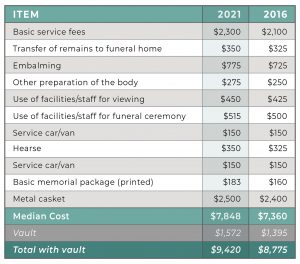
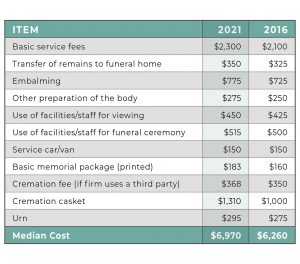
The National Funeral Directors Association (NFDA), the world’s leading and largest funeral association and a trusted leader in the funeral service profession, regularly conducts a survey tracking the average cost of a funeral. Their most recent survey looked at the average cost of a funeral in 2021 as compared to 2016 (5-year span). Two types of funerals were surveyed (both pertaining to adults): 1) a funeral with viewing and burial, and 2) a funeral with viewing and cremation.

1. Funeral with Viewing and Burial

*Source: http://www.nfda.org/news/statistics

2. Funeral with Viewing and Cremation

*Source: http://www.nfda.org/news/statistics

Most of the items listed are fairly self-explanatory, but you may be wondering what the “basic service fee” includes. Generally, basic service fees cover a proportionate amount of overhead, which includes the services of the funeral director and staff, facility maintenance and utilities, equipment and inventory cost, taxes and insurance, and other administrative expenses.

3. Direct Cremation/Direct Burial

The total cost of direct cremation or direct burial will be lower than the figures listed above. This is mainly because direct options do not typically include a memorial service. But again, the fees will vary depending on what state you reside in and which funeral home you choose. It’s important to make sure you are comparing apples to apples if you find what looks like a good price or special offer. Ask questions, and be sure that the package includes everything you and your family are looking for in a cremation or burial plan.

Get an accurate cost estimate from a funeral home near you

Remember, the average cost does not reflect the highest or lowest prices. Since prices can vary by region, you can get a more accurate picture of the cost of a funeral in your area simply by asking. Every funeral home is required by law to provide you with a General Price List upon request. With this resource in hand, you can look for the options that best fit your needs and budget and gain a more accurate picture of the cost of funerals in your area.

Food, flowers, and obituaries

Please note that the average cost of a funeral outlined above does not include services that are not provided by the funeral home. Most funeral homes refer to these costs as “cash advance items.”

However, these items can usually be coordinated by the funeral home and included in the funeral contract. “Cash advance items” may include, but are not limited to:

  • Church or venue charges (if you decide not to use the facilities available at the funeral home)
  • Flowers
  • Officiating clergy honorarium
  • Specialty music (should you decide to bring in a musician who requires payment)
  • Obituary/Death notice in a newspaper or online
  • Police escort to gravesite
  • Cemetery charges (the cost of a plot or niche and the opening/closing of the grave)
  • Grave marker charge
  • Reception venue
  • Catering
  • Clean-up services
  • Copies of the death certificate

As you can see, the answer to the question “What is the average cost of a funeral?” is difficult to pin down. In the end, the total cost will depend on many factors, including which funeral home you choose, where you live, how elaborate or simple you want the service to be, etc.

Once you have an accurate cost estimate, your next step is to consider how you want to pay for the funeral. Paying in advance can often lock in the funeral costs at today’s prices. This will help your family to save money in the long run.

Focus on hands of two people as they hold mugs

12 Tips for Loving the Grieving During the Christmas Season

By Christmas, Exclude from Top Posts, Seasonal

It’s Christmas time. Twinkling lights are going up, parties are being planned, and cookies and treats galore are baking in ovens across the nation. But even as happy tidings are shared between neighbors, we can’t forget that many of our neighbors, friends, and family members are grieving and hurting deeply. Grief is not relegated to certain parts of the year. But how can we be sensitive to the emotional needs of those around us who are hurting during this festive time?

Grandmother surrounded by her children and grand-children at Christmas

As nationally renowned grief expert, author, and counselor, Dr. Alan Wolfelt, puts it, “…it is important to recognize that helping a grieving friend will not be an easy task. You may have to give more concern, time and love than you ever knew you had. But this effort will be more than worth it. By ‘walking with’ your friend in grief, you are giving one of life’s most precious gifts – yourself.”

Consider these 12 tips for how to interact with your grieving friends or loved ones this Christmas.

1. Recognize and accept that they are hurting.

Person sitting at window, next to Christmas tree, looking quiet and sad

We may want our grieving loved one to “enjoy” the holiday season, but we need to make sure that we aren’t pushing too hard. What you consider enjoyment and what your grieving friend considers enjoyment will look completely different. They are going to experience a myriad of emotions throughout the holidays. Let them experience these emotions, and be a safe person to talk to about them. Above all, don’t try to avoid people who are grieving. They are already hurting; let’s not add our own discomfort to the load they are carrying.

2. Encourage them to set healthy boundaries.

Young woman sitting in a chair alone, wrapped in a blanket, with a sad look on her face

The grieving person will have limited energy, so it’s important that they figure out what will work for them during this busy season. No, they shouldn’t entirely shut out all things Christmas, but they should limit what they do, depending on their needs. If you are close to someone who is grieving, encourage them to set boundaries. Then, be prepared to support those boundaries, abide by them, and if necessary, help your grieving loved one fight to keep them.

3. Give them plenty of notice about an event or gathering.

Six friends getting together for a holiday brunch, lots of food, looking down from above

More often than not, someone who is grieving needs time to work up the energy to go out to an event or gathering. Make sure you them give plenty of notice so they can mentally and emotionally prepare. Also, don’t forget that you are encouraging them to put down healthy boundaries for the holidays. Don’t be offended or hurt if they decide not to come to your party.

4. Look for ways to honor the memory of the lost loved one.

Woman sits near a grave marker with red flowers in her arms, wearing a dark winter coat

You can do any number of truly special and unique things to honor a lost loved one. Buy or make a special gift. Sit down with your grieving friend and share memories or stories of the lost loved one. Join your grieving friend for a special trip to the gravesite. Donate to the lost loved one’s favorite charity. Find out if a local funeral home or church is facilitating a remembrance service and invite your grieving loved one.

5. Don’t force old traditions; come up with a new tradition together.

Red stockings on the mantle, one of the more common western Christmas traditions

Depending on who has died, the old traditions may be too painful. If it’s appropriate, sit down with your grieving loved one and talk about which traditions to keep this year and which ones to put aside. You might consider coming up with a brand-new tradition that will breathe some fresh air into the season.

6. Invite them to take part in a Christmas service project.

Volunteering at a donation center during the Christmas season

When we grieve, we can sometimes become so focused on the strong emotions we are feeling that we forget to come up for air. It’s a good practice to focus on others so that we can let our minds rest from the grief for a while. Invite your grieving friend to volunteer at a soup kitchen, to make blankets for the homeless, or to participate in another opportunity available through the church or community.

7. Make room for them and be ready to help.

A group of five friends sitting together inside, talking together

When someone is grieving, they often want to be alone and not be an inconvenience to those around them. Make sure that your grieving loved one knows that you have time for them and want them to be a part of your Christmas season. Practically speaking, be available, be inclusive, and be ready to offer help and support.

8. Encourage them to take care of themselves.

Young woman taking a nap on the couch with Christmas tree nearby, participating in self-care

In times of grief, people often feel overwhelmed, tired, and emotionally spent, and because of this, it’s important to take care of ourselves even while we grieve. Invite your grieving friend for a walk. Ask your grieving mother if she’d like a cup of hot cocoa or tea. If you have a grieving friend or family member visiting you for the holidays, turn down the covers of the guest bed, and let them know it’s ready if they’d like to take a nap. If you know their favorite foods, prepare something just for them and take it to their home, staying for a short visit. Show them that it’s okay to enjoy the simple pleasures even if their loved one is gone.

9. Don’t offer advice. Listen.

Two guy friends talking, one patting the other on the shoulder

It’s important that we allow people to grieve at their own pace and to be mindful of the words we say. Make sure that you don’t make assumptions about their grief. Try not to make comparisons to how you have mourned a loss in the past. Make sure to give them choices – if you force them into something, it likely won’t end well. More than anything, they need you to listen, to be present, and in many cases, to be silent.

10. Look for practical ways to offer help.

Two people wrapping Christmas gifts together on a table filled with paper, tape, bows

The holidays often mean lots of planning and preparation. For someone who is grieving, the things that once brought great joy may now feel pointless or like they are too much work. So, look for ways that you can help. Offer to help put up the Christmas tree or wrap presents. Ask them if they’d like to come to your home for a baking extravaganza (or perhaps they’d rather you come to theirs). If they need to shop for gifts, offer to go with them, or if they have a list, to pick up what they need. You may have some other great ideas for personal and meaningful ways to practically help your grieving loved one.

11. Send a thoughtful holiday card.

Woman sitting at table, writing a message in a Christmas card

For many, Christmas time means sending cards with holiday cheer to friends and family. Though the practice has dwindled somewhat in recent years, it’s a valuable way to tangibly show that you care about someone and are thinking of them. Consider putting some extra time and thought into what you might say in a meaningful card, words that will comfort and bring hope.

12. Follow up after the holidays to see how they are doing.

Focus on hands of two people as they hold mugs

We aren’t always the best about following through on things, but in this case, let’s try to put extra effort in. It’s important for a grieving person to know that your love and concern aren’t just temporary but are true and sincere. Make sure to reach out and offer your support all through the year.