
The Love Languages of Grief: Identifying and Asking for the Most Effective Grief Support for You

By Grief/Loss

When it comes to mourning and how others can best help us, there’s no one right way. Every person and every loss is unique. The people we grieve the loss of – as well as the circumstances of the loss – are also one-of-a-kind. After a significant loss, what we think and feel inside, in what ways we’re able to express those thoughts and feelings, and how we feel supported by others vary from person to person and loss to loss.

Yet, in his landmark 1995 book The Five Love Languages, author Dr. Gary Chapman introduced us to the idea that human beings feel cared for by others in five primary ways:

  1. Receiving gifts
  2. Spending quality time together
  3. Hearing words of affirmation
  4. Being the beneficiary of acts of service
  5. Experiencing physical touch

According to Dr. Chapman, each of us “speaks” one of the five love languages. In other words, we feel most loved when we experience the language best suited to our unique personalities and ways of being in the world. We might also respond  to a second or third love language, but we always prefer our primary love language.

In reviewing Dr. Chapman’s love languages recently, I realized that grouping the various helping techniques in this way could help mourners understand and recognize which forms of support and communication might be most effective for them.

I invite you to consider the following five ways of being supported in your grief. Which love language helps you the most?

1. Receiving gifts

In Dr. Chapman’s body of work, gifts of love are actual gifts – tangible, visible objects that we give to someone we care about as a means of expressing our affection and devotion. People whose primary love lan­guage is receiving gifts see presents as physical symbols of others’ love and thoughtfulness.

Do you enjoy getting presents? Are you someone who displays gift items in your home and feels a burst of love and support each time you see them? If so, receiving gifts might be your love language.

If you are someone who values the love language of gifts, consider letting your friends and family know that you really feel supported by tokens of empathy. You might appreciate flowers, for example. You might welcome gifts of food, in­spirational books, photo frames, music, candles and ornaments.

With this love language, it can be tricky to ask for what you need. “Please give me gifts!” would be considered impolite by many. Still, consider sharing what you’ve learned about your love language with a good friend or empathetic family member who is also an excellent com­municator. Perhaps she/he can take on the role of explaining to others the lasting meaning and ongoing support you find in physical objects.

And when you do receive a gift, be sure to write a heartfelt note of thanks or make a thank-you phone call.

2. Spending quality time together

For many people, there is no present more precious than the gift of presence.

Do you love spending time with the people who care about you? Do you enjoy their company, even when you’re not doing anything special together? Do you prefer company to solitude? If so, quality time might be your love language.

Let friends and family know the best way they can help you during your time of grief is simply to be there for you – literally. You crave and need their physical presence. Maybe you don’t want to be alone. Maybe you like lots of people around. If so, tell them.

Think about how you like to spend time with others. Playing cards? Watching TV? Going out and about? Hanging out in the same house but doing separate activities? Whatever you prefer, let friends and family know because they may feel unsure about what to do.

Consider, too, if you feel supported when you have the opportunity to talk to others about your grief. In general, sharing your story of love and loss is a good idea. It helps you work through your thoughts and feelings. Bottling those thoughts and feelings up inside can seem safer, but it’s actually more dangerous because it puts you at risk of becoming stuck in your grief journey.

Of course, your friends and family members aren’t the only ones who can help you with this love language. Be proactive about getting involved in your community. Volunteering, participating in activities at a place of worship or community group, socializing with neigh­bors – these are all effective ways to build in more quality time with other people.

And don’t forget that grief never completely ends. If this is your love language, you will need the healing presence of friends and family not just in the first month or  two after the death but far into the future. Reaching out to plan ongoing get-togethers will help you receive the support you need.

3. Hearing words of affirmation

This griever feels most supported by words that are kind and encouraging. “Words of affirmation” might be your love language if you have a deep appreciation for hearing others tell you:

  • I love you.
  • I care about you.
  • I’m here for you for.
  • You are so loved/strong/genuine because _______________.
  • I have seen how you _______________.
  • You make a difference in the world by ______________.
  • Many people ______________ you.

If this describes you, let your friends and family know how meaningful you find it when they share these kinds of verbal mes­sages with you. Tell them that their words of encouragement and support lift you up and help you through the darkest times.

Written words may be affirming to you as well. While they’re no replacement for in-person or phone conversations, handwritten notes, emails, and even texts may also be helpful and encouraging to you. If you’re a verbal griever, be sure to encourage all forms of spoken and written communications.

4. Being the beneficiary of acts of service

For some grievers, actions speak more loudly than words or mere presence. Do you appreciate help with tasks? Do you feel cared for when others go out of their way to help you with things that need doing? If so, this might be your love language.

Since the death of your loved one, have others said to you, “Let me know if I can do any­thing?” It’s a natural impulse for friends and family members to want to do some­thing to show their support. Usually what happens, though, is that grievers don’t ask for assistance, so no assistance takes place.

So please, ask for assistance! People often do genuinely want to help, but they don’t know how. Suggest tasks and to-dos that suit their strengths. Ask your gardener friends to help with yard work, for example. Ask your book­keeper family member to help with home accounting, bill paying, or tax preparation.

If one of your friends or family members is a good administrator, you might sit down with this person and go over all of the tasks that you need help with right now. This person can then assign the tasks out to others in your circle of support.

Finally, if this is your love language and you’ve asked your inner circle for help with tasks but aren’t receiving it, don’t be reticent to reach out beyond your inner circle. Others are waiting in the wings. Places of worship, volunteer organizations, neighborhood committees – these and other service­-oriented groups often have programs and maintain lists of volunteers to assist with needs such as yours. It is likely that helping grieving families is something they would be glad to do. All you have to do is ask.

5. Experiencing physical touch

The griever who thrives on physical touch needs closeness. Are you someone who enjoys hugging, sitting close to others, maintaining eye contact, holding hands, and/or walking arm-in-arm? If so, this might be your love language.

If you’re someone who’s always valued physical touch, your friends and family members will know to expect it from you. Don’t stop now! You may, however, want to emphasize to them how extra-necessary you find their hugs and physical closeness during your time of grief.

If this is your love language, you might also be more prone to physical symptoms of grief. It’s common for people in mourning to experience stomachaches, heart palpi­tations, headaches, lack of sleep, and other physical symptoms. If bodily problems are making it hard for you to function and focus on healing, it’s a good idea to schedule a physical exam. Your primary caregiver may be able to help you with insomnia or other symptoms and put fears of illness to rest as well.

Those who crave touch will be soothed by regular contact. In addition to physical closeness with family and friends, physical activity may help you right now. Or consider inviting someone to take a walk with you each day. Physical proximity combined with exercise and supportive conversation may be just what you need to feel loved and supported right now.

I believe Dr. Chapman’s love languages offer a helpful framework for recognizing and understanding your own primary love language so that you know how to ask for and receive the most effective support in your grief. If you are interested in learning more about the love languages, you may want to read one of Dr. Chapman’s books on the topic. He has written versions focused on partners, parenting children, men and other types of relationships. The original and flagship title in the series was reissued in 2015 by Northfield Publishing under the title The Five Love Languages: The Secret to Love That Lasts.

About the Author:

Dr. Alan Wolfelt is a noted author, educator, and grief counselor. Dr. Wolfelt believes that meaningful funeral experiences help families and friends support one another, embrace their feelings, and embark on the journey to healing and transcendence. Recipient of the Association of Death Education and Counseling’s Death Educator Award, Dr. Wolfelt presents workshops across the world to grieving families, funeral home staffs, and other caregivers. He also teaches training courses for bereavement caregivers at the Center for Loss and Life Transition in Fort Collins, Colorado, where he serves as Director. Dr. Wolfelt is on the faculty of the University of Colorado Medical School’s Department of Family Medicine. He is also the author of many bestselling books, including Understanding Your Grief, The Mourner’s Book of Hope, Creating Meaningful Funeral Ceremonies, and The Paradoxes of Grief: Healing Your Grief With Three Forgotten Truths. For more information, visit www.centerforloss.com

Printed by permission of Dr. Alan D. Wolfelt, all rights reserved.
9 Funeral Costs That Are Often Overlooked

By Plan Ahead, Planning Tools

Funeral costs can be a tricky thing to pin down if you are trying to plan ahead and protect your family by setting aside funds for a funeral in advance. After all, you don’t know what you don’t know, and you may be overlooking a few items in your estimate. If you are planning a funeral or considering advance funeral planning, there are certain funeral costs that are actually often overlooked. With any funeral, there will be services that are not expressly provided by the funeral home. These third-party services go by the name of “cash advance items.”

To put it simply, a family will advance funds to the funeral home, who will then use those funds to pay for third-party services on the family’s behalf. Of course, the family will first approve these funeral costs. According to The Funeral Rule, set in place by the Federal Trade Commission, a funeral home can mark up the price for cash advance items, but they must disclose how much the service is marked up in their General Price List (GPL). As an additional protection for you, as the consumer, The Funeral Rule requires that a funeral home inform you if any refunds, rebates, or discounts applied to the cash advance items you requested.

That said, if you feel that the mark up is not commensurate to the task, you can always take care of arranging these third-party services on your own. However, keep in mind that in most cases, families don’t have the time or energy to take care of all the necessary details in a short amount of time. Instead, they rely on the funeral home to take care of these needs so that they can focus on spending more time with their loved ones.

Some of the most commonly overlooked funeral costs are:

1. Death Certificates

First of all, most people don’t realize how many death certificates they will need. Keep in mind, the state or municipality determines the cost of a death certificate, and it can change over time. As a general rule, purchase multiple copies – more than you think you will need. Copies of a death certificate are typically requested for life insurance policies, social security or veterans’ benefits, stocks, bonds, banks, or for any number of other documents or establishments.

2. Cemetery and Monument Charges

Whether you choose burial or cremation, you will likely need to consider cemetery costs in your plans. Cemetery charges would include the cost of a burial plot or a niche in a columbarium or mausoleum, plus any fees associated with opening and closing the grave. Also, consider the cost of a plaque or monument, along with a monument or plaque installment fee. The cemetery proprietor and monument or plaque company determine these fees because many funeral homes do not own a cemetery or monument company themselves.

3. Obituary/Death Notice

Many people are surprised at the cost associated with publishing an obituary or death notice in a newspaper, especially in a larger city. In most cases, the funeral home will publish an obituary to the funeral home’s website, but if you wish to post it elsewhere, the fee may be higher than you expect.

4. Church or Venue Charges

If you choose to have a funeral or memorial service outside the funeral home’s facility, the venue you choose may charge a fee to use the space. Be sure to set aside enough for the rental of a space for the funeral service, visitation, and reception after the funeral.

5. Specialty Music

If you elect to have special music, it is likely that an honorarium will be necessary. Additionally, the musician/group you choose to hire will determine the cost.

6. Officiant Honorarium

It is customary to offer an honorarium to the officiant or celebrant. In many cases, this will be a clergy person. A friend of the family may officiate for free if you agree to this arrangement in advance. However, be sure to communicate clearly with the clergy person who takes their time to prepare a personalized eulogy. Also, be aware that independent celebrants will set their own fee.

7. Flowers

Depending on the time of year, the cost of flowers will fluctuate. Unfortunately, this makes it hard to pin down an actual cost. Again, the funeral home is not likely to have its own florist (though some may). The funeral home can purchase floral arrangements on your behalf.

8. Pallbearers

In many cases, pallbearers are family members and friends. However, for some, it is difficult to find a full six to eight pallbearers. If you require assistance with pallbearers, the funeral home can help you hire the help needed. The pallbearers will expect payment for services rendered.

9. Police Escort

Finally, it is common practice to request a police escort for the funeral procession from the funeral home to the final resting place. With an escort, the funeral procession is able to move through traffic in an orderly way and without traffic delays. The cost associated with this service is determined by local rates.

While not all-inclusive, this list shares nine of the funeral costs that most people don’t usually consider. If you are interested in planning ahead, you can sit down with a funeral director or advance planning specialist. You may want to discuss getting an accurate funeral cost estimate that includes cash advance items. That way, you can carefully consider how much money to set aside for these expenses when the need arises. A funeral professional can help you determine an accurate amount based on local and customary rates.


The Healing Power of Ritual

By Grief/Loss, Meaningful Funerals

Throughout our lives, we participate in rituals. In some cases, we may not even know that we are taking part in a ritual. At weddings, we toss the bouquet. And there’s the old adage for brides: something old, something new, something borrowed, something blue. We all have our holiday traditions (rituals) that we look forward to year after year. Graduation ceremonies are another wonderful example of a ritual that marks a milestone in life. And birthdays – most of us celebrate them yearly with either great or modest, and sometimes reluctant, fanfare. And, for those who are spiritual, holy days throughout the year are full of ritual, tradition, and significance.

But what does the term “ritual” really mean? The word has Indo-European roots and means to “fit together.” It is related to words like “order,” “weaving,” and “arithmetic.” All of these words involve fitting things together to create order. Rituals fit, or put, things back together. This is especially important for a meaningful and healing funeral experience.

When a loved one dies, it makes sense to turn to rituals to help us put our lives back together again. Grief is chaotic and disorienting. It rips our world apart. In fact, the word “bereaved” comes from the root “reave,” which means to be robbed by force. “Grieve” stems from French root “grever,” meaning to burden, afflict, or oppress. The elements of a healing funeral are rituals that work together to restore order to our lives after everything is torn apart by the chaos and pain created by the death of someone loved.

The Comforting Nature of Rituals

Even with a clearer definition, the question still remains, what is it about rituals that is so comforting?

They encourage us to remember

To begin with, rituals connect us to the past and provide stability for the future. As we remember what has gone before, we are comforted by those memories. At Christmas, we often find joy in remembrance of Christmases past. At funerals, we seek to remember, to value, and to honor the life of a uniquely special person.

They bring us together

Rituals also bring us together as families and communities. Whether it is gathering for Good Friday services or joining in the town’s Fourth of July parade every year, we come together, we support each other, and we find unity.

They offer us peace

In many ways, by taking part in rituals, we actively seek peace within ourselves. For example, it gives us a measure of internal peace to pray when someone is sick or injured. Or, after someone we love has died, we receive comfort when we visit their final resting place or do something special and significant on the day of their birth or death. By taking part in ritual, an intentional habit to recall and reminisce, we find comfort and a release for our pain.

They give us focus

By participating in powerful rituals, we gain a sense of focus. We take our eyes off ourselves and see beyond our own difficulties. If you decide to volunteer at a local soup kitchen in tribute to a lost loved one, you are not focused on your own needs but on the needs of another.

They help us in our search for meaning

And finally, rituals play a significant role in our search for meaning. Religious rituals are part of an inner search for meaning and purpose. A search for meaning is found in natural, normal rituals: visiting the graves of lost loved ones, reciting vows at a wedding, and celebrating a significant day. We are all constantly searching for significance and purpose, and rituals are a powerful tool in the search.

The Funeral Ritual

In much the same way, the funeral is a ritual that humankind has participated in since the beginning of time. Noted author, counselor, and grief expert, Dr. Alan Wolfelt, puts it this way:

The funeral ritual, too, is a public, traditional and symbolic means of expressing our beliefs, thoughts and feelings about the death of someone loved.  Rich in history and rife with symbolism, the funeral ceremony helps us acknowledge the reality of the death, gives testimony to the life of the deceased, encourages the expression of grief in a way consistent with the culture’s values, provides support to mourners, allows for the embracing of faith and beliefs about life and death, and offers continuity and hope for the living.


By taking part in the elements of a meaningful and healing funeral service, we participate in the long-held and necessary tradition of the funeral. By taking time to mourn, we learn to reconcile with grief and move forward to find continued meaning in life.

Funerals encourage us to remember those we have lost. They bring us together as families, friends, and communities. They offer us peace as we are faced with the reality of our grief and begin to reconcile ourselves to it. Symbols – lighting candles, wearing dark clothing, attending services – give us focus and intentionality. And perhaps most of all, they help us in our search for meaning, our search to understand where we come from and who we are.

What is the Average Cost of a Funeral?

By Plan Ahead

Similar to a wedding, a funeral is a very significant event, commemorated by a gathering of family and friends and a ceremony, followed by a reception. The funeral fulfills a necessary role in our grief journeys and helps us find comfort surrounded by loved ones. As Dr. Alan Wolfelt, grief expert, counselor, and author, says, “The funeral ritual…is a public, traditional and symbolic means of expressing our beliefs, thoughts and feelings about the death of someone loved.”

So, how can we prepare for the cost of such a significant life event? After all, there are no do-overs for a funeral! For reference, in the United States, the average cost of a wedding in 2021 was $34,000 (including the engagement ring), according to a survey of 15,000 couples. Additionally, the overall cost was vastly different depending on what state you married in: $47,000 for a wedding in New Jersey while it was $17,500 for a wedding in Utah. Many times, a similar type of variance will exist in regard to funeral costs and planning simply because it is a very similar type of event.

Keep in mind that just as every wedding is different, every funeral is different. Because of this, the final costs will vary based on personal preferences and the needs of the family, as well as their budget. Some will choose cremation over burial, a funeral service over a memorial service, a flat grave marker over a monument. Each of these individual choices will affect the overall cost.

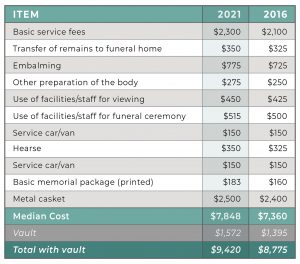
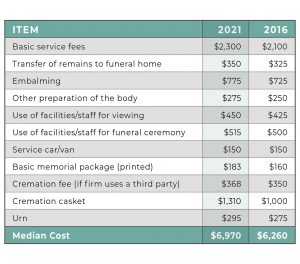
The National Funeral Directors Association (NFDA), the world’s leading and largest funeral association and a trusted leader in the funeral service profession, regularly conducts a survey tracking the average cost of a funeral. Their most recent survey looked at the average cost of a funeral in 2021 as compared to 2016 (5-year span). Two types of funerals were surveyed (both pertaining to adults): 1) a funeral with viewing and burial, and 2) a funeral with viewing and cremation.

1. Funeral with Viewing and Burial

*Source: http://www.nfda.org/news/statistics

2. Funeral with Viewing and Cremation

*Source: http://www.nfda.org/news/statistics

Most of the items listed are fairly self-explanatory, but you may be wondering what the “basic service fee” includes. Generally, basic service fees cover a proportionate amount of overhead, which includes the services of the funeral director and staff, facility maintenance and utilities, equipment and inventory cost, taxes and insurance, and other administrative expenses.

3. Direct Cremation/Direct Burial

The total cost of direct cremation or direct burial will be lower than the figures listed above. This is mainly because direct options do not typically include a memorial service. But again, the fees will vary depending on what state you reside in and which funeral home you choose. It’s important to make sure you are comparing apples to apples if you find what looks like a good price or special offer. Ask questions, and be sure that the package includes everything you and your family are looking for in a cremation or burial plan.

Get an accurate cost estimate from a funeral home near you

Remember, the average cost does not reflect the highest or lowest prices. Since prices can vary by region, you can get a more accurate picture of the cost of a funeral in your area simply by asking. Every funeral home is required by law to provide you with a General Price List upon request. With this resource in hand, you can look for the options that best fit your needs and budget and gain a more accurate picture of the cost of funerals in your area.

Food, flowers, and obituaries

Please note that the average cost of a funeral outlined above does not include services that are not provided by the funeral home. Most funeral homes refer to these costs as “cash advance items.”

However, these items can usually be coordinated by the funeral home and included in the funeral contract. “Cash advance items” may include, but are not limited to:

  • Church or venue charges (if you decide not to use the facilities available at the funeral home)
  • Flowers
  • Officiating clergy honorarium
  • Specialty music (should you decide to bring in a musician who requires payment)
  • Obituary/Death notice in a newspaper or online
  • Police escort to gravesite
  • Cemetery charges (the cost of a plot or niche and the opening/closing of the grave)
  • Grave marker charge
  • Reception venue
  • Catering
  • Clean-up services
  • Copies of the death certificate

As you can see, the answer to the question “What is the average cost of a funeral?” is difficult to pin down. In the end, the total cost will depend on many factors, including which funeral home you choose, where you live, how elaborate or simple you want the service to be, etc.

Once you have an accurate cost estimate, your next step is to consider how you want to pay for the funeral. Paying in advance can often lock in the funeral costs at today’s prices. This will help your family to save money in the long run.

Focus on hands of two people as they hold mugs

12 Tips for Loving the Grieving During the Christmas Season

By Christmas, Exclude from Top Posts, Seasonal

It’s Christmas time. Twinkling lights are going up, parties are being planned, and cookies and treats galore are baking in ovens across the nation. But even as happy tidings are shared between neighbors, we can’t forget that many of our neighbors, friends, and family members are grieving and hurting deeply. Grief is not relegated to certain parts of the year. But how can we be sensitive to the emotional needs of those around us who are hurting during this festive time?

Grandmother surrounded by her children and grand-children at Christmas

As nationally renowned grief expert, author, and counselor, Dr. Alan Wolfelt, puts it, “…it is important to recognize that helping a grieving friend will not be an easy task. You may have to give more concern, time and love than you ever knew you had. But this effort will be more than worth it. By ‘walking with’ your friend in grief, you are giving one of life’s most precious gifts – yourself.”

Consider these 12 tips for how to interact with your grieving friends or loved ones this Christmas.

1. Recognize and accept that they are hurting.

Person sitting at window, next to Christmas tree, looking quiet and sad

We may want our grieving loved one to “enjoy” the holiday season, but we need to make sure that we aren’t pushing too hard. What you consider enjoyment and what your grieving friend considers enjoyment will look completely different. They are going to experience a myriad of emotions throughout the holidays. Let them experience these emotions, and be a safe person to talk to about them. Above all, don’t try to avoid people who are grieving. They are already hurting; let’s not add our own discomfort to the load they are carrying.

2. Encourage them to set healthy boundaries.

Young woman sitting in a chair alone, wrapped in a blanket, with a sad look on her face

The grieving person will have limited energy, so it’s important that they figure out what will work for them during this busy season. No, they shouldn’t entirely shut out all things Christmas, but they should limit what they do, depending on their needs. If you are close to someone who is grieving, encourage them to set boundaries. Then, be prepared to support those boundaries, abide by them, and if necessary, help your grieving loved one fight to keep them.

3. Give them plenty of notice about an event or gathering.

Six friends getting together for a holiday brunch, lots of food, looking down from above

More often than not, someone who is grieving needs time to work up the energy to go out to an event or gathering. Make sure you them give plenty of notice so they can mentally and emotionally prepare. Also, don’t forget that you are encouraging them to put down healthy boundaries for the holidays. Don’t be offended or hurt if they decide not to come to your party.

4. Look for ways to honor the memory of the lost loved one.

Woman sits near a grave marker with red flowers in her arms, wearing a dark winter coat

You can do any number of truly special and unique things to honor a lost loved one. Buy or make a special gift. Sit down with your grieving friend and share memories or stories of the lost loved one. Join your grieving friend for a special trip to the gravesite. Donate to the lost loved one’s favorite charity. Find out if a local funeral home or church is facilitating a remembrance service and invite your grieving loved one.

5. Don’t force old traditions; come up with a new tradition together.

Red stockings on the mantle, one of the more common western Christmas traditions

Depending on who has died, the old traditions may be too painful. If it’s appropriate, sit down with your grieving loved one and talk about which traditions to keep this year and which ones to put aside. You might consider coming up with a brand-new tradition that will breathe some fresh air into the season.

6. Invite them to take part in a Christmas service project.

Volunteering at a donation center during the Christmas season

When we grieve, we can sometimes become so focused on the strong emotions we are feeling that we forget to come up for air. It’s a good practice to focus on others so that we can let our minds rest from the grief for a while. Invite your grieving friend to volunteer at a soup kitchen, to make blankets for the homeless, or to participate in another opportunity available through the church or community.

7. Make room for them and be ready to help.

A group of five friends sitting together inside, talking together

When someone is grieving, they often want to be alone and not be an inconvenience to those around them. Make sure that your grieving loved one knows that you have time for them and want them to be a part of your Christmas season. Practically speaking, be available, be inclusive, and be ready to offer help and support.

8. Encourage them to take care of themselves.

Young woman taking a nap on the couch with Christmas tree nearby, participating in self-care

In times of grief, people often feel overwhelmed, tired, and emotionally spent, and because of this, it’s important to take care of ourselves even while we grieve. Invite your grieving friend for a walk. Ask your grieving mother if she’d like a cup of hot cocoa or tea. If you have a grieving friend or family member visiting you for the holidays, turn down the covers of the guest bed, and let them know it’s ready if they’d like to take a nap. If you know their favorite foods, prepare something just for them and take it to their home, staying for a short visit. Show them that it’s okay to enjoy the simple pleasures even if their loved one is gone.

9. Don’t offer advice. Listen.

Two guy friends talking, one patting the other on the shoulder

It’s important that we allow people to grieve at their own pace and to be mindful of the words we say. Make sure that you don’t make assumptions about their grief. Try not to make comparisons to how you have mourned a loss in the past. Make sure to give them choices – if you force them into something, it likely won’t end well. More than anything, they need you to listen, to be present, and in many cases, to be silent.

10. Look for practical ways to offer help.

Two people wrapping Christmas gifts together on a table filled with paper, tape, bows

The holidays often mean lots of planning and preparation. For someone who is grieving, the things that once brought great joy may now feel pointless or like they are too much work. So, look for ways that you can help. Offer to help put up the Christmas tree or wrap presents. Ask them if they’d like to come to your home for a baking extravaganza (or perhaps they’d rather you come to theirs). If they need to shop for gifts, offer to go with them, or if they have a list, to pick up what they need. You may have some other great ideas for personal and meaningful ways to practically help your grieving loved one.

11. Send a thoughtful holiday card.

Woman sitting at table, writing a message in a Christmas card

For many, Christmas time means sending cards with holiday cheer to friends and family. Though the practice has dwindled somewhat in recent years, it’s a valuable way to tangibly show that you care about someone and are thinking of them. Consider putting some extra time and thought into what you might say in a meaningful card, words that will comfort and bring hope.

12. Follow up after the holidays to see how they are doing.

Focus on hands of two people as they hold mugs

We aren’t always the best about following through on things, but in this case, let’s try to put extra effort in. It’s important for a grieving person to know that your love and concern aren’t just temporary but are true and sincere. Make sure to reach out and offer your support all through the year.

Young woman sitting on couch at home at Christmas, listening to music on headphones

A Christmas Playlist for the Grieving Heart

By Christmas, Exclude from Top Posts, Seasonal

The Christmas season can be especially difficult for those who are grieving. Many Christmas songs are lighthearted, happy, and discuss themes of romantic love, family, or joyfulness. But maybe you don’t feel very happy this Christmas…maybe this is the hardest Christmas you’ve ever faced. For that reason, we’ve compiled this list of songs. This Christmas Playlist is meant to help you  grieve during the Christmas season. Just because the culture says you should be light and joyful doesn’t mean you have to put on a cheerful face and pretend you aren’t hurting. Be where you are, but also try to look for ways to enjoy Christmas on your own terms and in your own way.

Young woman sitting on couch at home at Christmas, listening to music on headphones

Most of us enjoy music. It helps us get in touch with our emotions. Music can bring us great joy, motivate us, challenge us, and bring tears to our eyes. This Christmas season, don’t be afraid to listen to music that helps you embrace your sadness. Dr. Alan Wolfelt, nationally-renowned grief expert, reminds us, “As you approach the holidays, remember: grief is both a necessity and a privilege. It comes as a result of giving and receiving love. Don’t let anyone take your grief away. Love yourself. Be patient with yourself. And allow yourself to be surrounded by loving, caring people.”

The songs included in this Christmas Playlist are diverse. Some are meant to help you embrace your sadness, some are meant to remind you of the good things still in your life, and some are meant to help you embrace the meaning of Christmas and the joys of your former Christmases. The list is not comprehensive – feel free to add songs that speak to your heart personally and remove songs that aren’t meaningful for you.

This Christmas is yours. Honestly consider what you truly need. Then, do what is best for you, unapologetically.

  • Have Yourself a Merry Little Christmas (Sam Smith)

Faithful friends who are dear to us
Gather near to us once more

First published in 1943, this song brought great comfort to many American soldiers who spent Christmas overseas on the battlefield. The song’s slow tempo and heartfelt words convey a sense of nostalgia. The listener is encouraged to remember past Christmases and look forward to future ones, but it does not negate the difficulty of the present Christmas.

  • Silent Night (Bing Crosby)

Silent night, holy night, wondrous star, lend thy light;
With the angels let us sing,
Alleluia to our King.

Silent Night is one of the most popular Christmas carols of all time and has been translated into over 300 languages. The song is familiar, comforting, and most importantly, calls us to look beyond our circumstances and remember why we have the season of Christmas.

  • Do You Hear What I Hear? (Carrie Underwood)

The Child, the Child, sleeping in the night
He will bring us goodness and light

Originally released just after Thanksgiving in 1962, this song was written as a response to the Cuban Missile Crisis. Tension spread across the United States, and many had mixed emotions during the Christmas season. Of all the lines, the ones that bring the most comfort are, “Pray for peace, people everywhere! Listen to what I say, the Child, the Child sleeping in the night, He will bring us goodness and light.” May you receive peace, goodness, and light this Christmas season.

  • Thankful (Josh Groban)

And on this day we hope for
What we still can’t see

First released on Josh Groban’s Christmas album, Noel, the lyrics do not carry a heavy Christmas theme. Instead, they focus on the fact that, even though you may be grieving, there is so much to be thankful for. Sit and let the soothing music flow over you and ponder what you can be thankful for during this time of sadness.

  • Where Are You, Christmas? (Faith Hill)

My world is changing
I’m rearranging
Does that mean Christmas changes too

This song tackles the ever-changing aspects of life, and as the world changes, so does the way we celebrate the holidays. As you deal with loss (no matter what kind of loss it may be), you must find your “new normal” and what life is going to look like for you now.

  • My Grown-up Christmas List (Kelly Clarkson)

But heaven only knows
That packages and bows
Can never heal
A hurting human soul

At its heart, this song is about the wish deep within us that the difficult things in life would disappear. As children, we asked our parents and Santa Claus for bikes, dolls, games, and candy, but as grown-ups, we see the pain in the world and ask for very different things. This song perfectly expresses the desire that every person would receive peace, hope, and love.

  • I Pray on Christmas (Harry Connick, Jr.)

I pray on Christmas
That God will lead the way
And I pray on Christmas
He’ll get me through another day

This jazz-inspired Christmas song from Harry Connick Jr. incorporates elements of gospel music. In his crooning style, Harry conveys the message that God will hear us, be with us, and get us through Christmas day. While still expressing the need to lean on others during hard times, the song is uplifting and soulful.

  • Merry Christmas, Darling (The Carpenters)

But I can dream and in my dreams
I’m Christmas-ing with you

Released in 1970 by brother-sister duo, The Carpenters, the lyrics were originally written in 1946, and then, put to music by Richard Carpenter. While the lyrics were written with deployed soldiers in mind, the words apply to anyone who is missing a loved one during the Christmas season. As you grieve this season, it’s okay to miss your loved one and to wish that they were still near.

  • River (Sarah McLachlan)

I wish I had a river I could skate away on
I wish I had a river so long I would teach my feet to fly

This song is real. In the opening lyrics, it reveals that Christmas time is coming, but all she really wants to do is skate away from her troubles and her grief. If you are grieving this Christmas, you may feel this way, too.

Allow the music to flow over you and bring your grief to the surface. Christmas won’t be the same this year. And it’s okay to be sad about it. Accept your emotions as they come and allow the music to give them a voice. This exercise will be one more step toward healing and figuring out what life looks like now.

How Family Interviews Can Make Your Thanksgiving Memorable

By Exclude from Top Posts, Seasonal, Thanksgiving

Thanksgiving is about reflection, remembrance, gratitude, and time spent with loved ones. Too often, we take our time on earth for granted, and before we are ready, a loved one is gone. While we are always aware that death will come one day to those we love, we aren’t prepared for that difficult day. But what if you could preserve the memory of your lost loved one, the stories of their life, the tone of their voice, and their beloved quirks of habit by conducting family interviews?

If the idea appeals to you, sit down with your living loved ones for an oral history interview. But what is an oral history interview, you may ask? Essentially, it entails intentionally spending time with someone, asking questions and recording answers. You may also see this practice called a family history interview or a life interview.

Why Should I Do This?

First and foremost, it’s a tangible way to show someone you love them. By sitting down with someone, spending one-on-one time with them, asking questions and sharing conversation, you add value to your and your loved one’s lives. You make them feel loved, appreciated, and that they are important to you. Also, think about what you could learn from your loved one’s successes, or even more importantly, from their mistakes? Did you know that your loved one used to go swing dancing every Saturday night as a young person? Did you know how they felt when their first child or grandchild was born?

People are simple and yet complex. So much of our lives take place internally. By asking questions, you can begin to know your loved one even more intimately and learn things about them that you may never have known.

Secondly, it’s a practical way to preserve family history for future generations, to discover the stories that bind our families together. In today’s world, so many people are interested in where they came from, what their ancestors were like, and what kind of life they lived. New websites pop up every day related to genealogy and family history. Do you want future generations to know something about your loved one? Take the time necessary to preserve your family’s story.

Thirdly, when the day comes that your loved one is gone, hopefully after a long and fulfilling life, you can take the information you’ve gathered and create a meaningful funeral service. Additionally, if you video your interviews, you will have priceless footage to use in the creation of a special tribute video that will be meaningful for the funeral service but also for future generations of family.

senior mom with her middle-aged daugther, smiling and hugging, wearing light pink blouses.

Who Should I Interview?

Whoever you want (but make sure to ask for permission first). You can interview your mom, dad, grandparents, aunts, uncles, a next door neighbor, or anyone else. You could even go down to an assisted living establishment and ask permission to interview some of the residents. Your interest in their lives might just make their day.

How Do I Do This?

  1. Determine what questions you will ask.

The first step is to decide what questions you want to ask. Thankfully, resources exist online that share in-depth, open-ended questions that you can ask your loved one. There are tips on interview etiquette, how to set goals for your interviews, and how to help everyone be at ease and enjoy the time together.

  1. Select a documentation medium.

The second step is to decide what medium you want to use to record your interviews. Some options are:

  • Handwrite everything in a special journal
  • Type everything on a computer
  • Use an audio recording app or other equipment
  • Film the interviews using a phone or other equipment
  • A mixture of these options or something else that’s easy for you
  1. Spend quality time with your loved one.

Lastly, go spend time with your loved one. Start this Thanksgiving Day! If you need more time (and you probably will), talk to them and decide what day and time is best for a chat, whether in person or over the phone. Let the conversation flow naturally. Don’t get hung up on trying to get all your questions answered at once. Just be there and absorb. Remember, you won’t get everything recorded in one sitting. Take time, and have fun!

Yes, Thanksgiving is a time when families come together, enjoy each other’s company, and share laughter and memories. This year, what better way to show your thankfulness for your loved ones than by intentionally getting to know more about their lives?

Facing Traumatic Events: 5 Keys to Resilience After Loss

By Current Events, Exclude from Top Posts

Snowstorms leave families trapped. Tornadoes rip through homes. Wildfires ravage forests and towns. Floods continue to devastate cities. Hurricanes batter our shores. As traumatic events seem to strike at every turn, people have no choice but to leave behind life the way they knew it – homes, cars, treasured mementos, family heirlooms. If you’ve been faced with loss — whether you have lost a loved one, a home, job, or a relationship — you know how important it is to slow down and give yourself time to process your feelings of grief. It is okay to feel sorrow over what has been lost. It’s normal, in fact! But through these catastrophic events, we never fail to see the human spirit rise above and keep living. So, what are some of the keys to this kind of resilience?

Simply defined, resilience is the ability “bounce back” from difficult circumstances. When faced with hardship, you adapt, find a way to rebuild your life, and come back better than ever.

Practically speaking, how can you live a resilient life while dealing with the devastation of loss and financial instability? In a very real sense, when we lose the possessions most precious to us, it’s almost as if we are losing a part of ourselves and our connection to the past. Thankfully, there are many ways to build your resilience, and it is not a quality a person is born with, but a quality that is cultivated. You can be resilient and come out better, no matter what your struggle.

As you walk down the road of grief, think of these five keys as stepping stones. This is not an exhaustive list of how you can cultivate a resilient life, but it is a beginning. It takes great strength to mourn fully and well while also taking those first steps forward to a new life.

  1. Allow Yourself to Grieve

It’s important to allow yourself to feel the emotions of your loss. It is a significant event to lose everything you’ve worked for, every possession that may have meaning to you. Don’t bottle up your emotions, thinking, “I should be grateful. I’m alive. What are a few things?” It does little good to belittle the loss that you feel. Acknowledge it, own the pain, and move toward healing. In one of the California fires, the home of “Peanuts” creator, Charles Schulz, burned to the ground. Jean Schulz, widow of Charles, shared that while the majority of “Peanuts” memorabilia is safely housed in a museum, she is devastated at the loss of the home she shared with Charles for 25 years as well as some irreplaceable keepsakes. The key is to give yourself permission to grieve.

  1. Take Care of Yourself

No matter what event or circumstance you may be grieving, it’s important to take care of yourself. Your mind and body are connected, so as you take care of your body, you care for your mind. Make sure to get enough sleep and exercise, and do not seek to dull your grief but experience it and express it. Making connections is also a big part of building resilience and maintaining personal well-being. Stay connected with family members, friends, support groups, faith-based groups, and non-profit organizations that can help you through a difficult time.

  1. Be Prepared for Grief Triggers

While most often associated with the loss of a loved one, grief triggers can be associated with any type of loss. There will be times when external circumstances – a word, smell, place – may trigger a memory in you, perhaps a painful one. For example, if you have lost everything in a fire, including your mother’s wedding dress that you hoped to wear on your own wedding day, it will bring back painful memories when your cousin says how excited she is to wear her own mother’s wedding dress. There will be moments when the pain resurfaces – count on it! – so do your best to prepare yourself so that when the strong emotions come, you aren’t blindsided by them.

  1. Give Yourself Time

There’s no rush, no time frame. Every person grieves differently, and there’s no set formula. It’s okay to take as long as you need to grieve but make sure you don’t get stuck in your grief. Dr. Alan Wolfelt, renowned grief counselor and author, says, “We don’t ‘recover from’ or ‘get over’ grief. Instead, we become reconciled to it. We learn to live with it and integrate it into our continued living. We come to reconciliation in our grief journeys when the full reality of the loss becomes a part of us. Healing is not returning to an old normal but rather creating a new normal.”

  1. Accept Change

The treasures of your old memories may be gone, and there may be nothing you can do but grieve their loss. Take the time you need to grieve, but also, remember that change is a part of life. There will come a time to build new memories. Don’t be afraid to live fully and build new, precious moments and cherish the keepsakes that go along with them. You are alive, so go live!

How You Can Help Now

If you would like to help families currently affected by natural disasters, consider giving of your time or resources to one of these organizations:

  1. United Way – raising funds to assist those who have lost their homes and possessions.
  2. American Red Cross – raising funds to assist families affected by disaster.
  3. UNICEF – provides children and families with disaster relief whenever emergencies strike.

Natural Disasters & Hurricanes: How Grief Can Help Us to Help Others

By Current Events, Exclude from Top Posts

What does it mean to grieve during a natural disaster or a hurricane? What opportunities does grief provide for helping others in need? In the wake of natural disasters that have caused so much damage to the lives of so many people, it’s useful to examine the relationship between healthy grief and compassionate action. While our first impulse may be to distance ourselves from the pain of tragedy, it’s necessary that we face this pain, because grief cultivates sympathy and compassion.

torndado

Awareness Spurs Action

It is difficult to wrap our minds around the information that we get from news statistics and apply them to the lives of everyday people. To picture the hundreds of lives lost, and to realize that each of these lives was as precious as that of our dearest loved one, is difficult to fathom. To envision the tens of thousands of homes destroyed or uninhabitable, and to know that each home belonged to an individual or a family who needs a home just as much as our families do, is beyond distressing.

But in response to the hurricanes, we’ve seen a number of heroic acts. Hundreds of Airbnb hosts are offering rooms to house Dorian evacuees. A Lakeland, Florida, hotel is seeing customers give up their own rooms or pay for rooms on behalf of evacuees. In North Carolina, volunteers are helping the elderly prepare for the storm. When hurricanes hit, we see people stepping up to make a difference. We see people showing that they care. This kind of commitment to goodness doesn’t come from a place of comfort. It comes from an awareness of the suffering of others. It comes from the internalization of their pain, and the channeling of this pain into sympathy, and ultimately, action.

We can only transcend the pain of loss by allowing ourselves to feel this hurt. As Dr. Alan Wolfelt says, we must go backward before we can go forward. In other words, we must allow ourselves to feel sad and painful emotions in order to move towards healing. The people who take action understand this essential truth of grief. They have opened themselves up to the suffering of others, and have chosen to expose themselves to pain and discomfort. By moving outside of themselves, they set an example of hope and goodness that is inspiring to all of us.

How You Can Help Those Affected by the Hurricane

In light of the recent natural disasters, you may want to consider ways in which you can help.  If you feel moved to take action, you have the opportunity to partner with organizations that are making a difference in the lives of those affected by these natural disasters, for example:

  • To give toward Hurricane Dorian disaster relief in the Bahamas, this article shares several ways you can help, including the Red Cross, World Central Kitchen, Global Giving, and other Bahamas-based organizations.
  • Americares has set up an Emergency Relief Fund for Hurricane Dorian so that you can help Americares offer medicine and medical assistance. A $10 donation can provide up to $100 in aid to those in need.
  • The Red Cross has a disaster relief program set up to bring aid to those affected by natural disaster.
  • The UNICEF Disaster Relief program works to meet the basic needs of children and their families who have been affected by Hurricane Dorian.

Grief is an avenue for change. It allows us to confront the reality of other people’s pain in order to better care for them. Because grief is unpleasant, our culture tends to downplay its importance. But shying away from painful emotions keeps us complacent. By crossing the threshold of sadness, we find the sympathy that connects us and reminds us of our common humanity.

By letting ourselves grieve, we allow ourselves to acknowledge the needs of those who are hurting. To bury the pain of this loss is to miss an opportunity to show compassion to others. It’s okay to temporarily welcome the sadness. Sadness reminds us that people are in a time of need. It provides a lens through which we can see more clearly to help others. It moves us from mourning to sympathy, from sympathy to action, and from action to inspiration. Tragedies of this kind are always distressing. However, we often find that in the midst of such hardship, humanity shines brightly.

Grief and Loss in the Wake of Hurricane Dorian

By Current Events, Exclude from Top Posts

Hurricane Dorian is lashing against the East Coast‘s shores, sure to cause life-threatening conditions, catastrophic flooding, and property damage. Hurricane Dorian is the first large hurricane of the season and has already devastated the Bahamas. In recent years, we have seen a number of hurricanes wreak massive amounts of damage, including Hurricanes Michael and Florence last year and Hurricane Harvey, Hurricane Irma, and Hurricane Maria the previous year. Together, these hurricanes contributed to the deaths of thousands and caused billions of dollars in property damage.

Losing everything so suddenly can be especially difficult to grapple with because all that is familiar–your home, your belongings, your pictures, even loved ones–are gone, washed away by an unrelenting storm.

The trauma of such a devastating and sudden loss can manifest as complicated grief. Be aware that total loss as a result of a sudden natural disaster can possibly trigger severe trauma responses, including anger, depression or anxiety, post-traumatic stress disorder. Usually, the severity of the response depends on previous life trauma and the support that survivors are able to find after the event.

If you are looking for ways to help others during this time, it is important not to put your own life in danger by going out into affected areas on your own. Consider volunteering with an existing organization or donating to worthy organizations that are making a difference in impacted communities.  This article shares ways to contribute to hurricane and disaster relief efforts.

If you know or are helping someone who has been affected by a recent disaster, the best thing you can do right now is listen to their story and offer tangible help in any way you can. Nothing will take away the pain of total loss. The rebuilding effort for both cities and individual lives will take time. There is not much that we can do to “fix it” or take their pain away. We can’t bring back homes, precious pictures, heirlooms, and loved ones. What survivors need right now is help with day to day necessities, as well as someone who is comfortable being a listening ear and a witness to their pain and loss.

Skip to content